
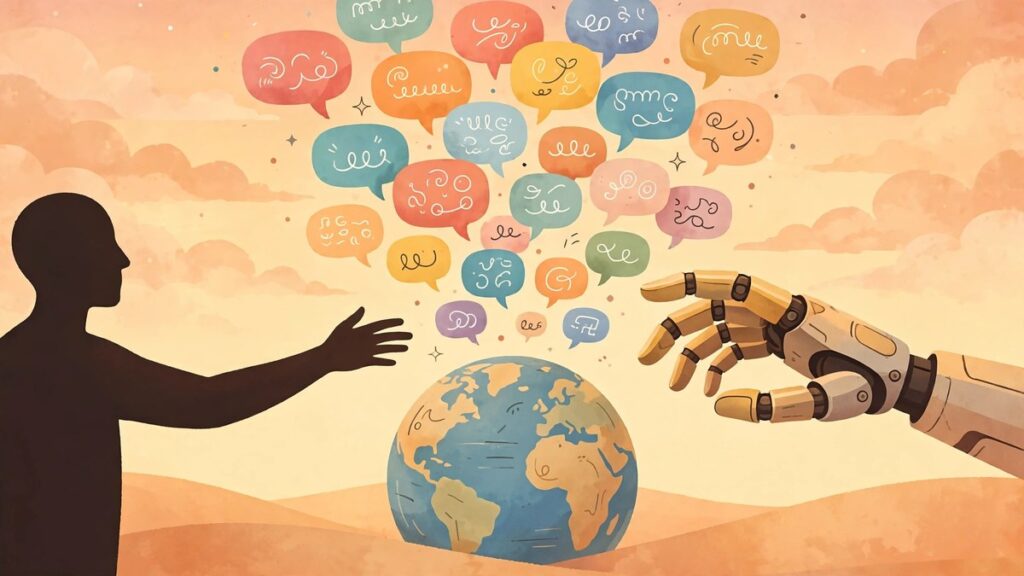
According to the BBC, artificial intelligence now dominates the translation business, yet human translators are still needed for high-stakes work. Machines can translate words quickly and cheaply, but for legal, medical and other sensitive jobs, people are still required to judge whether the result is accurate and appropriate.
The change in the job is already visible. VUB senior lecturer Koen Kerremans told the Belgian university that translators increasingly receive a pre-translated text to check and correct, so the work is shifting from translation itself towards checking, revising and verifying. That still requires a very high level of language proficiency and subject knowledge, he said.
The limits of the machines show up in live work. Industry reporting notes that interpretation happens in real time, once something is said it cannot be taken back, and AI systems still struggle with ambiguity, multiple speakers and specialised terminology. A European survey of the language industry found the same weaknesses in legal, medical and business settings, where the consequences of an error are significant.
Demand for human interpreters is still growing, according to industry reporting, particularly for legal, medical and conference work among organisations in regulated environments. Human translators AI tools support, rather than replace, are increasingly the people who check machine output, judge whether it fits the audience and culture, and take responsibility when it does not.
Why it matters
The reason humans survive in this story is that translation is not really about words. An AI can process what is visible in language, the vocabulary, the grammar, the broader context, and it does that faster and cheaper every year. But communication also carries intentions, registers, cultural expectations and things left unsaid, and those are invisible to a system that has never sat in the room. Kerremans' point is the sharpest version of this: an AI translation can be linguistically correct and still be unsuitable for the context in which it is used, and only a human can tell the difference.
The stakes decide where the line falls, and that is why the profession is splitting rather than disappearing. For a product description, a hotel review or an internal email, machine translation is already good enough, and the market has accepted it. For a court testimony, a medical consent form or an asylum interview, a single wrong word can change a legal outcome, a diagnosis or a life, and no organisation wants a machine to carry that risk alone. The result is a two-tier market: machines handle the routine volume, humans concentrate on the work where error is expensive.
There is a workforce problem hiding inside that split. If entry-level and routine assignments are automated, the pipeline that trains the next generation of highly skilled interpreters narrows, because beginners learn on easy work before they are trusted with hard cases. The profession will need new ways to train people, perhaps through supervised post-editing and monitored AI sessions, or it will find in ten years that the experts it needs were never given the chance to become experts. That is a planning problem for universities and employers, not a technology problem.
The accountability question is the one that will decide the legal future of the field. When a human interpreter makes an error, a judge or a clinician can question them, and professional codes and language-access laws require qualified humans in federally funded services and courtrooms. An AI cannot be cross-examined, cannot explain its reasoning and cannot take responsibility. Until the law finds a way to assign that responsibility to a machine, the human stays in the room for the same reason a pilot stays in the cockpit of an automated plane.
What to watch next
Watch the courts and hospitals, where the rules are being written now. If regulators require a qualified human to review AI interpretation in high-stakes settings, the hybrid model becomes the standard, and the market for human post-editing grows with every new AI deployment.
Watch the training pipeline too. Universities that teach students to work with AI, check its output critically and specialise in high-stakes domains will produce the translators the market still needs, while courses that teach translation as if machines did not exist will quietly become irrelevant.
Frequently asked questions
How long will humans be needed for translation?
For the foreseeable future in high-stakes work. AI handles routine translation well, but courts, hospitals and other sensitive settings still need humans to judge accuracy, culture and context.
What is changing about translators’ jobs?
The work is shifting from translating from scratch to checking and correcting machine output, a role that still needs deep language skill and subject knowledge, according to VUB lecturer Koen Kerremans.
Why can’t AI replace interpreters?
Interpretation happens live and cannot be taken back, and AI still struggles with ambiguity, multiple speakers, specialised terms and cultural nuance, especially in legal and medical settings.
Is demand for human interpreters falling?
No. Industry reporting says demand is growing for legal, medical and conference interpretation, even as AI takes over routine, low-risk work.


