
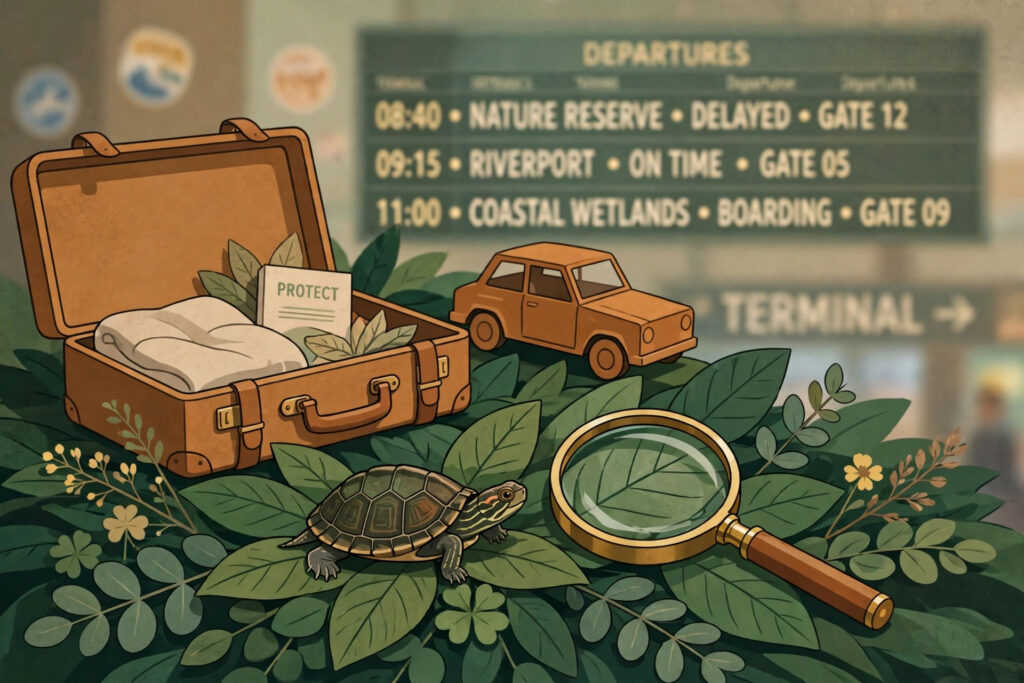
According to Reuters, Dutch authorities seized 26 critically endangered Vallarta mud turtles at Amsterdam's Schiphol Airport last week, the Dutch Food and Consumer Product Safety Authority said on Friday. The turtles were found on 21 November during a routine inspection of a man's checked baggage as he travelled from Mexico to Hong Kong via Amsterdam.
The turtles had been wrapped in duct tape to stop them moving, with most packed together in a box along with a toy car and a few others placed inside a sealed sock in the suitcase. People reports that all 26 animals survived the journey and were taken to a specialist animal rescue centre, where the tape was carefully removed and they are now receiving care.
The Vallarta mud turtle, known to science as Kinosternon vogti, was only formally described by scientists in 2018 and lives in the wild only in a small area of western Mexico. Only around 300 remain in the wild, according to Reuters, so the seizure of 26 animals may have removed nearly 10 percent of the wild population in a single journey.
Why it matters
The numbers in this story are what make it so shocking, and they deserve a moment's attention. Twenty-six turtles sounds like a small seizure, until you learn that only around 300 of these animals remain in the wild. That means one suitcase, on one flight, may have taken nearly a tenth of an entire species. Conservation is usually a story of slow decline, measured in percentages over decades. This is a story of a species being carried away in luggage, and the arithmetic is brutal.
The price explains the crime. Vallarta mud turtles can sell for up to 30,000 dollars each, according to the US-based Center for Biological Diversity, cited by Reuters. That puts a suitcase of 26 turtles at a potential street value approaching three quarters of a million dollars, for animals small enough to fit in a sock. The economics of wildlife trafficking are often described in abstract terms, but this case makes them concrete: a tiny, rare animal, a huge price, and a smuggler willing to tape living creatures into a box for a flight across the world.
Schiphol is not a random setting for this seizure. Amsterdam's airport is one of Europe's great transit hubs, and the route in this case, from Mexico to Hong Kong via the Netherlands, is exactly the kind of multi-leg journey traffickers use to obscure a shipment's origin. Customs officers found the turtles during a routine inspection, which is both reassuring and worrying: reassuring because the system worked, worrying because it worked by chance. Nobody knows how many similar suitcases pass through the world's airports unopened.
The species itself is a reminder of how recently science even knew this animal existed. The Vallarta mud turtle was only formally described in 2018, and it is one of the world's smallest freshwater turtles, growing to only about four inches long. It lives exclusively in a small area of western Mexico, which makes it both precious and vulnerable: a single collector, or a single bad year, can do damage that a widespread species would absorb. It is listed as critically endangered on the IUCN Red List and has the highest level of protection under CITES, the international treaty on wildlife trade.
Mexico's role in this story is complicated. The turtles were presumably stolen from the wild in Mexico, according to the Dutch authorities, and the Center for Biological Diversity has previously called on the Mexican government to do more to protect them. That is a familiar pattern in wildlife crime: the country that holds the species bears the cost of protecting it, while the demand, and the money, comes from collectors abroad, often in Asia, where rare reptiles are prized as pets and status symbols. Enforcement at the destination matters, but it cannot substitute for protection at the source.
There is a hopeful note, and it is that all 26 turtles survived. Animals smuggled in luggage often do not, and the fact that these were found alive, and are now in specialist care, means the story does not have to end in loss. The Dutch authorities have encouraged the public to report suspected illegal wildlife trade, including sales through online marketplaces and forums, which is where much of this trade now happens. The man arrested at Schiphol remains in custody while the investigation continues, and the case will test whether the law can match the scale of the crime.
What to watch next
Watch what happens to the turtles next, and whether they are repatriated to Mexico. Returning seized animals to the wild is complex, requiring health checks and a suitable release site, but it is the outcome conservationists will hope for, and it would restore a meaningful share of the wild population.
Watch too for the prosecution and for any wider investigation. A single courier is rarely the whole network, and the authorities will be looking for who supplied the turtles, who was meant to receive them in Hong Kong, and how the trade was arranged online.
Frequently asked questions
What species was found at Schiphol Airport?
Twenty-six Vallarta mud turtles, known to science as Kinosternon vogti, one of the world’s smallest freshwater turtles and a critically endangered species found only in western Mexico.
How were the turtles hidden in the luggage?
The turtles were wrapped in duct tape to stop them moving. Most were packed together in a box with a toy car, and a few others were placed inside a sealed sock in the passenger’s suitcase.
How many Vallarta mud turtles are left in the wild?
Only around 300 remain in the wild in Mexico, according to Reuters. The seizure of 26 animals may have removed nearly 10 percent of the wild population in a single journey.
What happens to the turtles now?
All 26 survived and were taken to a specialist animal rescue centre, where the duct tape was removed and they are receiving care. The man arrested at the airport remains in custody while the investigation continues.


