
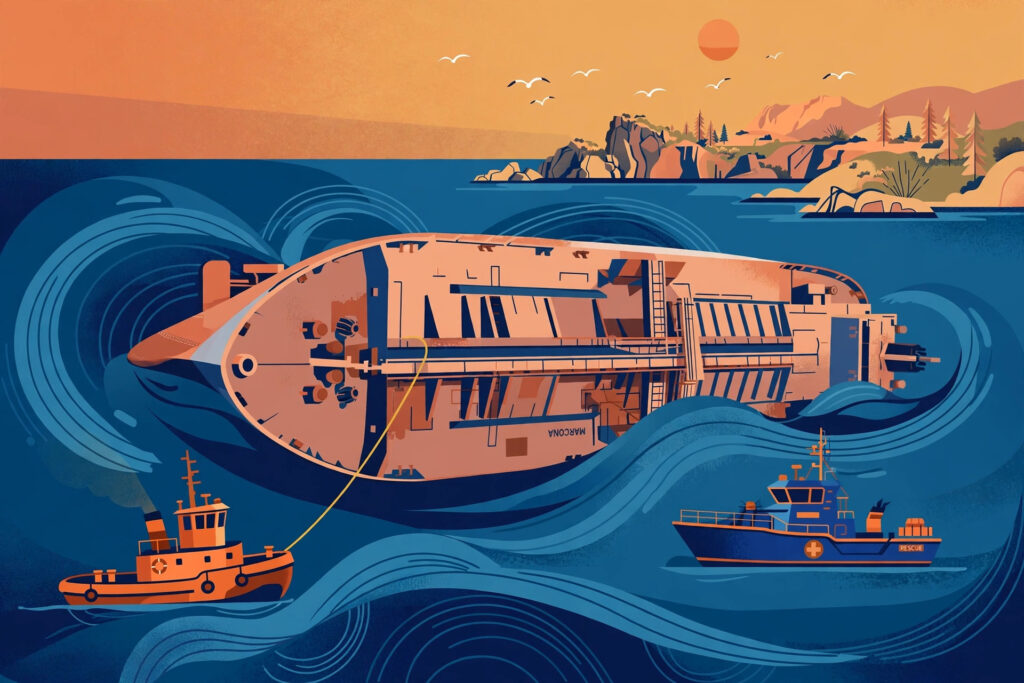
According to Free Malaysia Today, a capsized tanker carrying 7,000 tonnes of diesel that sparked ecological fears off Spain's Mediterranean island of Ibiza will be towed to port. The Maltese-flagged Med Emre overturned early on Thursday, killing its chief engineer, while the fuel has so far been contained, authorities said.
The ship's 17 crew were rescued, but the chief engineer, a 46-year-old Turk, died in hospital after the rescue, and six others suffered minor injuries, notably hypothermia. Dawn reports the vessel was sailing from Algeciras to Barcelona when the captain reported rapid water ingress into the ballast tanks, and the ship lost stability and capsized in under an hour, in waves of up to four metres.
Spain has approved a salvage plan to tow the capsized tanker to the port of Cartagena, with arrival expected on Monday. The Maritime Executive reports that Cartagena was chosen as the only port in the region meeting the technical requirements for cargo extraction and repairs, and that divers inspected the hull and tanks on Friday while the pollution-control vessel Clara Campoamor holds the wreck with a tow line.
Why it matters
The first piece of good news in this story is that the fuel has stayed in the ship. A capsized tanker carrying 7,000 tonnes of diesel off a Mediterranean island is the kind of incident that can become an environmental catastrophe, and for the first two days the authorities have been able to say the leak is not happening. Spain's Prime Minister Pedro Sánchez told Cadena SER radio that the information suggests the leak is not happening, and the maritime captain of the port of Valencia said a small slick had disappeared and the situation is stabilised. That is a fragile reassurance, but it is a real one.
The second piece of news is the human cost, which should not be lost in the salvage logistics. The chief engineer, a 46-year-old Turkish seafarer, died in hospital after being rescued, and four crew members remained hospitalised with hypothermia, dehydration, saltwater ingestion and petroleum exposure, while one had a broken leg. A ship capsizing in under an hour, in four-metre waves, in the dark, is a terrifying event, and the fact that 16 of 17 crew survived is a tribute to the rescue operation, including the nearby cable-laying vessel that recovered the captain and three crew.
The decision to tow the vessel to Cartagena, rather than to a port closer to Ibiza, reveals the scale of the engineering problem. The Med Emre is lying keel-up, upside down but not fully sunk, and it needs 27 to 29 metres of water clearance even in its capsized state. Cartagena is the only port in the region that meets the technical requirements for extracting the cargo and carrying out repairs. The Balearic Islands authorities opposed bringing the vessel closer to the islands, which is understandable: Ibiza's marine environment is a UNESCO World Heritage site, home to dense Posidonia oceanica seagrass meadows, and a spill there would be devastating.
That fear has a name in Spain: Prestige. In 2002 the Prestige tanker spilled more than 60,000 tonnes of fuel off Galicia, in the country's worst environmental disaster, and the memory shapes every decision made about the Med Emre. The comparison is also reassuring in one respect: the Prestige broke apart and spilled its cargo, while the Med Emre's hull is reported intact, with the Interior Minister saying there is no risk of a spill. But the Prestige also teaches that the danger grows with time, and that a damaged ship at sea is a problem that must be solved quickly, before weather or structural failure makes the choices worse.
The salvage itself will be slow and difficult, and the public should not expect a quick resolution. Fuel extraction at sea was judged not feasible, because it requires sheltered waters, so the salvors, SMIT Salvage and Ardentia working with Spain's maritime rescue service Salvamento Marítimo, will explore hot tapping into the tanks once the vessel is in port, and a containment collar will be deployed. Removing the fuel and righting the ship will take several weeks. The timeline is measured in weeks, not days, and the weather will decide how fast the tow can proceed.
Finally, there is the question of why a modern ship, built in 2019 and 120 metres long, with no issues in its last Port State inspection, capsized at all. The emerging account is that water entered the ballast tanks rapidly, the vessel listed 90 degrees within minutes of the distress call, and stability was lost. The cause is still under investigation, and it would be wrong to speculate beyond what the captain reported. But the shipping industry will be watching the investigation closely, because a ballast failure on a well-maintained, seven-year-old tanker raises questions that go beyond one ship and one voyage.
What to watch next
Watch for the tanker's arrival in Cartagena on Monday, and for the first reports from the salvage operation. The condition of the tanks, the success of the hot-tapping plan, and the weather during the tow will decide whether the fuel stays contained through the most delicate phase of the operation.
Watch too for the investigation into the cause. The captain's report of rapid water ingress into the ballast tanks is the starting point, and the findings will matter to the ship's owners, its insurers, and to regulators across the shipping industry.
Frequently asked questions
What happened to the tanker off Ibiza?
The Ibiza tanker capsized early on Thursday 26 November 2026, about 25 nautical miles from Ibiza, while sailing from Algeciras to Barcelona with 7,000 tonnes of diesel aboard. It is lying upside down but has not fully sunk.
Was there an oil spill from the Med Emre?
No major spill has been confirmed. Authorities say the fuel has so far been contained, a small slick seen early on has disappeared, and the ship’s hull is reported intact.
Where is the tanker being towed?
Spain has approved a plan to tow the Med Emre to the port of Cartagena, expected to arrive on Monday. Cartagena is the only port in the region meeting the technical requirements for cargo extraction and repairs.
Did anyone die in the capsizing?
Yes. The chief engineer, a 46-year-old Turkish crew member, died in hospital after the rescue. The other 16 crew were rescued, though six suffered minor injuries including hypothermia.


