
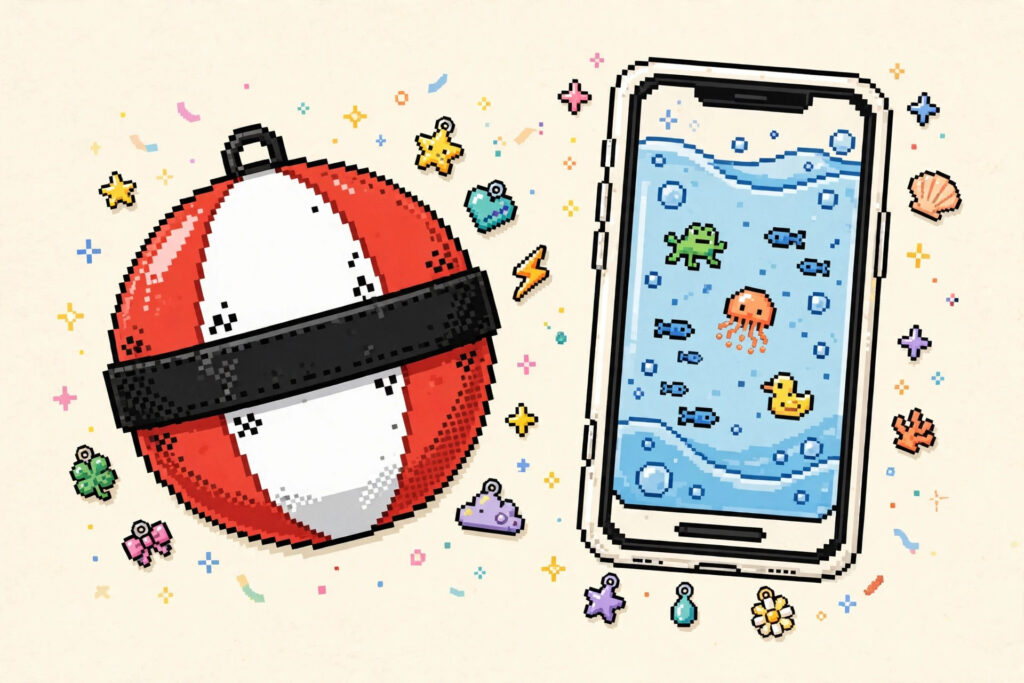
According to Engadget, Casetify will release a new Pokémon collection on 1 December, headlined by an AirPods case designed to resemble a Poké Ball. The accessories brand announced the range on 24 November, and a waitlist is already open ahead of the launch on its website, app and in stores worldwide.
The star item is a spherical, 3D pixel-art Poké Ball case that opens to reveal the AirPods inside, designed to look as if it came from the old 2D pixel Pokémon games. Android Headlines reports the collection also includes a Pokémon Adventure Shake Shake phone case, with a liquid-filled compartment on the back containing pixel Pokémon and Poké Ball charms that move when shaken.
Other items include simpler phone and AirPods cases, a Pikachu phone charm that lights up, and a phone strap decorated with Pikachu, Bulbasaur, Charmander, Squirtle and a Poké Ball. USA Today notes the collection marks 30 years of Pokémon and 15 years of Casetify, and that the company has not yet announced the price of the Poké Ball case.
Why it matters
The Poké Ball AirPods case is a small object that carries a large amount of cultural weight. Pokémon turns 30 this year, which means the children who first caught them on a Game Boy in the 1990s are now adults with disposable income and a powerful nostalgia reflex. Casetify knows this audience intimately, and a spherical case that looks like it stepped out of a pixelated game is not really a tech accessory. It is a totem, a way of carrying a piece of childhood in a pocket, and that is why the waitlist opened before anyone knew the price.
The pixel-art design is a clever choice, and it shows how carefully Casetify understands its market. A realistic Poké Ball would be a novelty item. A pixel-art Poké Ball is a design statement, a reference to the 8-bit games that the core audience actually played, and it signals taste rather than fandom alone. The Shake Shake case works the same way: a liquid-filled compartment with floating pixel charms is playful, but it is also the kind of tactile, shareable detail that photographs well and spreads on social media without any advertising.
Pricing is the one thing Casetify has not revealed, and the silence is probably strategic. Engadget notes that the company's Darth Vader head AirPods case launched at 138 dollars and now sells for 98 dollars, while its Evangelion Unit-01 case is listed at 110 dollars. That puts the Poké Ball case in a bracket where the price is part of the story: high enough to feel special, low enough to be an impulse buy for a fan. Announcing the price on launch day, rather than at the reveal, keeps the conversation going and the waitlist growing.
There is a broader pattern here that goes beyond one collection. Casetify has built its business on collaborations, turning phone cases into canvases for franchises, artists and brands, and selling them through 80 retail locations worldwide as well as its website and app. The model works because a phone case is the most visible accessory a person owns, seen by everyone they meet, and because fans will pay a premium for an object that says something about who they are. Pokémon, with 30 years of goodwill and a fanbase that spans generations, is close to the perfect partner.
The missing product is almost as interesting as the ones announced. USA Today notes that some fans asked why there is no case for the newly released iPhone Duo, Apple's first foldable, and that Casetify had not specified which devices the phone cases are compatible with. That gap is a reminder of how fast the phone market moves: a collaboration planned months ago can arrive just as the hardware landscape shifts, and accessory makers are always one product cycle behind the phones they dress.
What the collection ultimately shows is how nostalgia has become one of the most reliable engines in consumer technology. Pokémon at 30 is not a children's brand that grew up; it is a brand that grew up with its audience, and its fans now buy premium accessories, attend anniversary events and pass the games on to their own children. Casetify's job is to give that affection a physical form, and a Poké Ball that holds your AirPods is about as literal a form as it gets.
What to watch next
Watch the launch on 1 December, when the price of the Poké Ball case is finally revealed and the first sell-out reports arrive. A fast sell-out would confirm the demand and likely trigger a second drop, while slow sales would suggest the waitlist was more curiosity than commitment.
Watch too for the iPhone Duo question. If Casetify adds cases for Apple's foldable, it will show the company can move quickly on new hardware. If not, the gap may become a talking point for fans who have already bought the new phone.
Frequently asked questions
When does the Casetify Pokémon collection launch?
The collection launches on 1 December 2026, dropping at 3 a.m. ET, and is available through the Casetify website, the Casetify Co-Lab app and physical stores worldwide. A waitlist is already open.
How much is the Poké Ball AirPods case?
Casetify has not announced the price yet. For comparison, its Darth Vader head AirPods case launched at 138 dollars and its Evangelion Unit-01 case is listed at 110 dollars.
What is in the Casetify Pokémon collection?
The range includes a 3D pixel-art Poké Ball AirPods case, a Shake Shake phone case with floating pixel charms, a light-up Pikachu phone charm, a Pokémon phone strap and simpler phone and AirPods cases.
Why is Casetify launching a Pokémon collection now?
The Casetify Pokémon collection marks 30 years of Pokémon and 15 years of Casetify, celebrating the anniversary with a pixel-art range inspired by the original 2D Pokémon games.


