
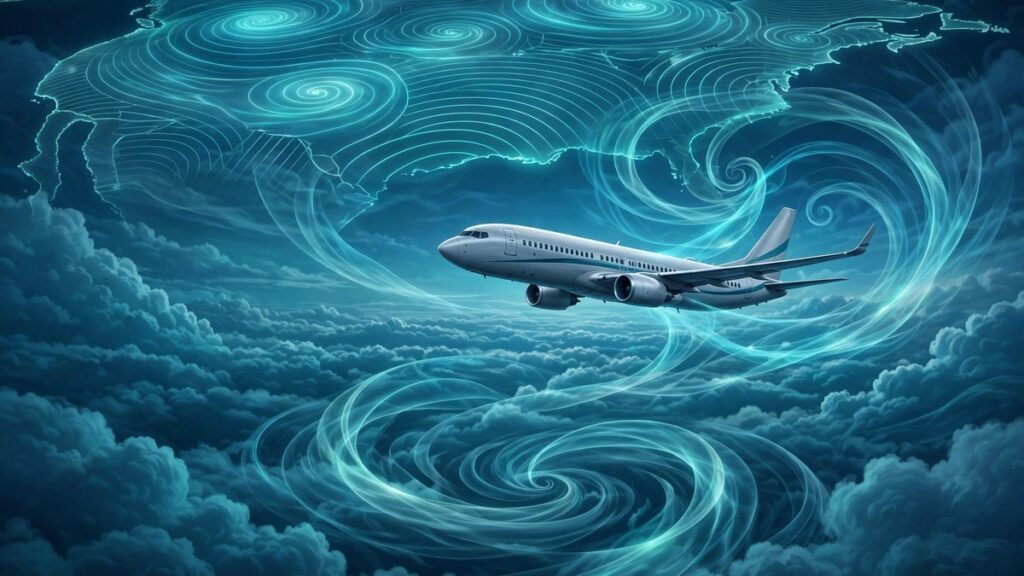
According to Wired, airplane turbulence is famously the hardest remaining problem in classical physics, but terabytes of crowdsourced data and new machine-learning weather models may finally change that. The turbulence prediction forecast you get today is often six to twelve hours old by the time you board.
Distratech reports that the International Air Transport Association's Turbulence Aware platform, launched in 2018, now pulls automated bump reports from more than 2,600 aircraft at over 25 airlines, including Delta, United, Air France-KLM, Qatar Airways and Emirates. The reports, called eddy dissipation rate readings, are computed from aircraft accelerometers every few seconds, and a reading of 0.4 means the same thing from a 737 or an A380.
TVNWorld reports that the Israeli company SkyPath has its software installed on more than 40,000 devices and is used by major airlines including American Airlines, giving pilots warnings 10 to 15 minutes ahead of rough air. Japan's BlueWX has built an AI deep-learning system that All Nippon Airways formally introduced in 2025 and ZIPAIR adopted in October 2026, achieving 86 percent accuracy for its Japanese operations. Google DeepMind's GraphCast can run a 10-day global forecast in under a minute, Distratech reports.
Why it matters
Turbulence is hard to predict because it is chaotic at every scale, from jet streams spanning continents to eddies the size of a room. Clear-air turbulence is the worst case: it arrives in cloudless skies with no visual cue and no radar signature, so pilots have historically relied on delayed reports from other aircraft or on general forecasts that prove insufficient in real time. The physicist Richard Feynman called it the most important unsolved problem in classical physics, and the description has stuck because the physics genuinely resists the usual tricks.
The change is not a better equation but a better dataset. A commercial airplane's engine generates 20 terabytes of data in an hour of flying, according to the International Air Transport Association, and the industry has finally started using it. Thousands of aircraft now report bumps objectively, every few seconds, and the reports are shared back to cockpits in near real time. That turns every flight into a sensor, and every sensor into a warning for the aircraft behind it.
AI weather models are the second half of the story. Distratech reports that Google DeepMind's GraphCast produces a 10-day global forecast at 0.25-degree resolution in under 60 seconds on a single chip, while the European Centre for Medium-Range Weather Forecasts' AI system has run operationally since early 2025. Traditional models run at roughly 9 to 13 kilometre resolution and take hours on a supercomputer. The urgency is growing: severe clear-air turbulence over the North Atlantic rose about 55 percent between 1979 and 2020, according to the University of Reading, and warmer air from carbon dioxide emissions is altering jet stream behaviour.
The stakes are human, not just operational. Around 80 percent of serious turbulence injuries happen to people who were not strapped in, Distratech reports, and the agency logged 163 serious injuries on US airlines from 2009 to 2022, mostly cabin crew. The Singapore Airlines flight SQ321 incident in May 2024, which killed one person and injured more than 100 over Myanmar, showed what a single encounter can do. Regulators in Europe and the United States are now reviewing whether automated bump reporting should become mandatory on new aircraft deliveries.
What to watch next
Watch whether automated reporting becomes mandatory. The European Union Aviation Safety Agency and the US Federal Aviation Administration are reviewing the question, and a mandate would turn today's voluntary network into a complete picture of the sky.
Watch the November to March peak season, when the jet stream is strongest and clear-air turbulence is at its worst. If the new systems cut injuries this winter, airlines will have their proof, and the technology will spread from flagship carriers to everyone else.
Frequently asked questions
Why is airplane turbulence so hard to predict?
Turbulence is chaotic at many scales, and clear-air turbulence arrives in cloudless skies with no visual cue or radar signature, Wired reports. Physicist Richard Feynman called it the most important unsolved problem in classical physics.
How does crowdsourced turbulence data work?
Aircraft report bump readings from their accelerometers every few seconds, Distratech reports. The IATA Turbulence Aware platform aggregates reports from more than 2,600 aircraft at over 25 airlines and shares them back to cockpits.
What is SkyPath?
SkyPath is a system that turns aircraft into mobile data collection platforms, TVNWorld reports. Its software is installed on more than 40,000 devices and gives pilots warnings 10 to 15 minutes ahead of rough air.
Has clear-air turbulence increased?
Yes. Severe clear-air turbulence over the North Atlantic rose about 55 percent between 1979 and 2020, according to the University of Reading, and November to March is peak season.
How many people are injured by turbulence?
Distratech reports 163 serious injuries on US airlines from 2009 to 2022, mostly cabin crew, and around 80 percent of serious injuries happen to people who were not strapped in.


