
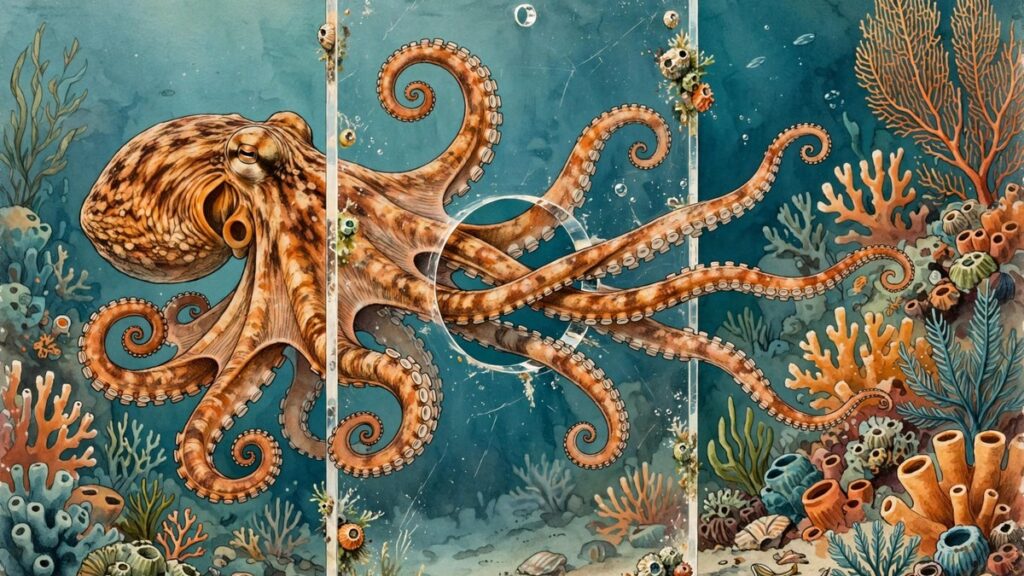
According to Smithsonian Magazine, octopuses squeeze through tiny holes using a three-step or four-step process, depending on the size of the opening. A study published November 5 in the Journal of Experimental Biology finally describes the step-by-step moves these escape artists use to cram into tight spaces.
Smithsonian reports that the researchers tested three subadult common octopuses and four juvenile Mayan octopuses, measuring the distance between each animal's eyes to size the semi-rigid cartilage casing around its brain. The holes ranged from about 0.4 to 1.4 inches. Lead author Wenci Xin is a roboticist at the National University of Singapore, working with Michael Kuba of the University of Naples Federico II in Italy and Tamar Gutnick of the Haus des Meeres-Aqua Terra Zoo in Austria.
When the opening was larger than the distance between the eyes, the common octopuses used a three-step manoeuvre, Smithsonian reports: probe the hole with one arm, snake a few more arms through, then use the arms already through to push against the back of the partition and pull the rest of the body through. When the hole was smaller, they split the final step in two, threading the remaining arms through first and then pulling the head and mantle through separately. The whole escape can take as little as 20 seconds, according to Phys.org.
Why it matters
The surprising part is not that octopuses can do this but that nobody had looked closely at how. Keepers have known for generations that an octopus can vanish through a gap in a tank, and the escape of Inky from New Zealand's national aquarium is famous. Yet the mechanics were unstudied, partly because the movement looks like magic: a boneless animal pouring itself through a hole smaller than its own head. Xin's team turned the trick into an experiment by building clear boxes with holes of precise sizes and filming every attempt.
The key measurement is the distance between the eyes, because that sets the size of the one part that cannot squish: the semi-rigid cartilage casing around the brain. An octopus body is mostly soft and pliable, with only two stiffer parts, that casing and a hard chitin beak. When the hole is wider than the eye distance, the three-step routine works; when it is narrower, the animal must compress even its head and mantle separately. Trevor Wardill, a neuroethologist at the University of Minnesota who was not involved in the study, noted that the level of brain distortion in a vertebrate would be like a massive concussion.
The Mayan octopuses add a puzzle. They used a similar strategy for larger holes, but when the hole was smaller they simply ignored it and did not even try, Smithsonian reports. The reason for the species difference is unclear, and it is a reminder that a behaviour is not a reflex: the same animal can choose caution over escape. That choice matters for anyone designing a robot on this model, because a machine that always attempts the squeeze will get stuck where a cautious octopus would wait.
The payoff is in robotics. Most search-and-rescue robots are long and slender, built to slide into a gap; an octopus-inspired robot could carry sensors, communication devices, and tools on flexible arms that probe, anchor, and pull. Xin says the capability could let robots overcome environmental limits and enter spaces that are difficult to reach. The study's authors also hope the work helps design soft robots for confined spaces, from collapsed buildings to industrial pipes, where a rigid machine cannot follow.
What to watch next
Watch for the first soft robots built on this three-step pattern. The study gives engineers a recipe, probe, thread, then pull, and the next step is a machine that can do it with sensors and tools attached.
Watch for follow-up studies on other species. If Mayan octopuses are cautious where common octopuses are bold, the difference may reveal how much of the behaviour is learned, how much is anatomy, and whether other cephalopods have their own escape routines.
Frequently asked questions
How do octopuses squeeze through tiny holes?
Common octopuses use a three-step or four-step process, Smithsonian Magazine reports: probe with one arm, thread more arms through, then push against the partition to pull the body through. Smaller holes add a fourth step.
What is the hardest part of an octopus to squeeze through?
The semi-rigid cartilage casing around the brain, sized by the distance between the eyes, Smithsonian reports. The only other stiff part is the hard chitin beak.
How long does it take an octopus to escape through a hole?
The whole escape can take as little as 20 seconds, according to Phys.org, once the octopus has threaded its arms through and anchored them on the far side.
Why did the Mayan octopuses not try the smaller holes?
When the hole was smaller than the distance between their eyes, the Mayan octopuses simply ignored it and did not even try, Smithsonian reports. The reason for the species difference is unclear.
How could this help build better robots?
The findings could help design soft robots for confined spaces, such as search and rescue, Smithsonian reports. An octopus-inspired robot could carry sensors and tools on flexible arms into spaces rigid machines cannot reach.


