
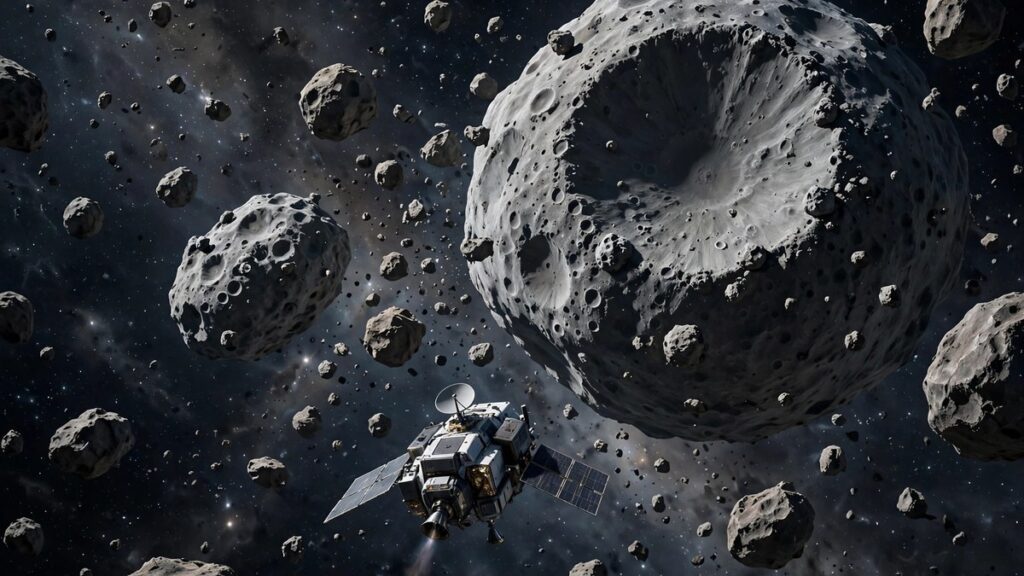
According to the European Space Agency, NASA's DART impact left a stadium-sized crater across the entire width of the asteroid Dimorphos, flattening one face of the 151-metre rock and sending it tumbling chaotically. The ESA's Hera mission, now flying nearby, has begun capturing images of the aftermath.
Engadget reports that the DART crater extends across the entire width of Dimorphos, yet it did not alter the fields of boulders that cover the rest of the asteroid. The ESA says Hera's cameras, a monochrome Asteroid Framing Camera, the multi-spectral Hyperscout H, and the Japanese-built Thermal Infrared Imager, captured the details from about 25 to 30 kilometres away.
NASA's DART spacecraft deliberately struck Dimorphos on September 26, 2022, shortening its orbit around the larger asteroid Didymos by 33 minutes, far more than predicted. Dimorphos is 151 metres across and orbits the 730-metre Didymos, and the pair is currently 193.5 million kilometres from Earth, according to the ESA. Hera also found that both asteroids are surrounded by hundreds of previously unknown boulders.
Why it matters
The crater matters because it answers the question DART could not answer on its own. Changing an orbit proves that deflection works in principle; seeing the crater shows what the impact actually did to the rock. A stadium-sized hole across the entire width of a 151-metre asteroid means the spacecraft did not just nudge a solid body, it reshaped one. That distinction decides whether future deflection missions can rely on a clean push or must account for a target that deforms, sheds boulders, and starts tumbling.
The tumbling is the surprise that will keep scientists busy longest. The ESA says Dimorphos is now tumbling chaotically in its orbit, and that hundreds of previously unknown boulders encircle the binary pair. Those boulders are both a hazard and a clue: a hazard because any future spacecraft approaching the pair must navigate a cloud of debris, and a clue because their distribution records how the impact energy moved through the asteroid. Hera's job is to turn that debris field into a measurement.
Timeline: NASA's DART spacecraft struck Dimorphos on September 26, 2022, shortening its orbit by 33 minutes; the ESA's Hera mission launched on October 7, 2024 and arrived at the asteroid pair in November 2026; in December 2026 Hera will move closer, to about 13 kilometres, for higher-resolution images; in January 2027 it will deploy two shoebox-sized CubeSats, Juventas and Milani, to probe the interior and prospect the dust. Hera is the ESA's first planetary defence mission, built by a consortium of 18 member states and led by OHB of Germany.
The bigger story is Earth's insurance policy. NASA and other space agencies are exploring asteroid deflection as one way of protecting the planet from potentially dangerous future impacts, and Hera mission manager Ian Carnelli says the two missions together are taking a decisive step towards making deflection a reliable tool. A reliable tool needs more than one successful test; it needs to know how different asteroids respond, how much warning is required, and what happens to the debris. Hera is collecting exactly that knowledge, one image at a time, 193.5 million kilometres away.
What to watch next
Watch December, when Hera moves to about 13 kilometres for sharper images of the impact site. Those pictures should show whether the crater has a raised rim, how deep it runs, and how the boulder fields are arranged.
Watch January 2027, when the CubeSats deploy. Juventas, built by a Luxembourg-led team, will use radar to probe the asteroid's interior and eventually attempt a landing, while the Italian-led Milani will prospect dust and surrounding material. The interior data is what turns a crater photograph into a physics model.
Frequently asked questions
How big is the crater left by NASA’s DART mission?
The crater is the size of a sports stadium and extends across the entire width of Dimorphos, according to Patrick Michel, Hera’s principal investigator, as reported by Engadget.
When did DART hit the asteroid Dimorphos?
NASA’s DART spacecraft deliberately struck Dimorphos on September 26, 2022, shortening its orbit around Didymos by 33 minutes, according to the ESA.
What is the ESA’s Hera mission doing now?
Hera is flying about 25 to 30 kilometres from the asteroid pair, capturing images with three instruments, the ESA says. In December it will move closer, and in January 2027 it will deploy two CubeSats.
How big is Dimorphos?
Dimorphos is 151 metres in diameter and orbits the 730-metre asteroid Didymos, according to the ESA. The pair is currently 193.5 million kilometres from Earth.
Why does the DART crater matter?
It shows what an asteroid deflection impact actually does to a rock, the ESA says. Hera mission manager Ian Carnelli says the two missions together are a decisive step towards making asteroid deflection a reliable tool for protecting Earth.


