
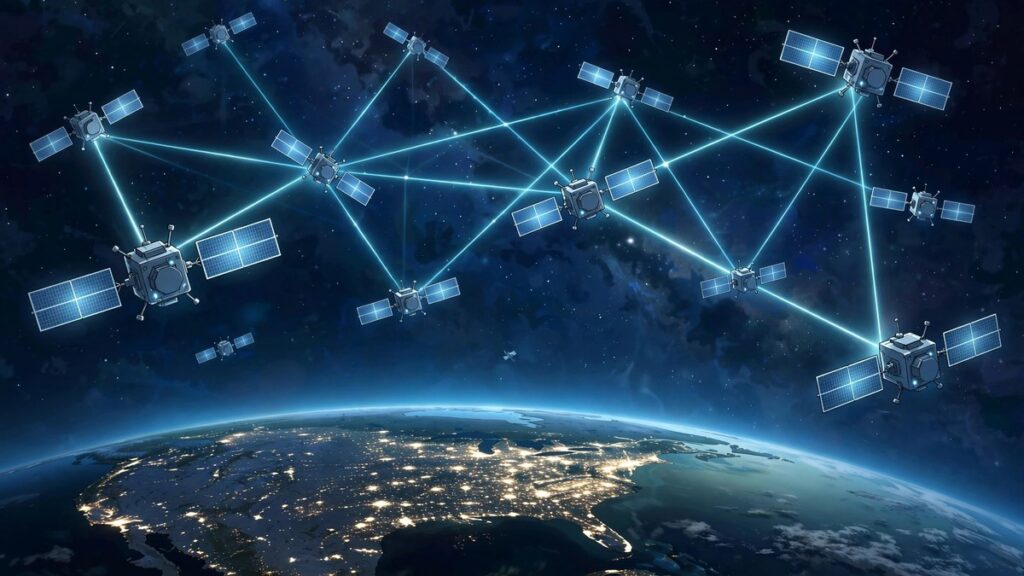
According to TechCrunch, the US Federal Communications Commission has given SpaceX conditional approval to deploy up to one million Starmind satellites that would form orbital data centres for artificial intelligence. The approval, granted on 25 November 2026, is a major regulatory win for Elon Musk, but the satellites are still years away from operating.
Engadget reported that the FCC expects the first Starmind satellite in orbit by November 2033, with 100,000 deployed by 2035 and the full million by 2040. SpaceX plans to place the satellites at altitudes between 500 and 1,002 kilometres, communicating mainly by laser links between satellites, with radiofrequency as a backup for control from Earth. The company argues orbital data centres are the most efficient way to meet rising demand for AI computing power, because they run on solar power with little operating and maintenance cost.
The approval came despite objections from Amazon, Viasat and the American Astronomical Society, which raised concerns about orbital debris, radiofrequency interference and environmental effects. Amazon, which is building a Starlink competitor, called the plan a lofty ambition rather than a real plan. The FCC dismissed some concerns, including threats to scientific research, because it decided they fell outside its regulatory authority. FCC chair Brendan Carr said the decision opens a bold new frontier for the computing infrastructure needed to power America's leadership and growth.
Why it matters
The appeal of putting data centres in orbit is easy to see from the ground. On Earth, a large AI data centre needs vast amounts of electricity and water for cooling, and communities near new sites increasingly object to both. In orbit, sunlight is constant and free, and there is no local grid to overload. SpaceX's argument, as Engadget reported, is that orbital data centres use solar power with little operating and maintenance cost, which is why the company calls Starmind the most cost and energy-efficient way to meet growing demand for AI computing power.
The physics, however, pushes back. Space is a vacuum, and a vacuum traps heat: unlike a data centre on Earth, an orbital server cannot dump waste heat into air or water, and must radiate it away instead. Astrophysicist Adam Becker told the Associated Press, in comments carried by Engadget, that there are basic physical limits to radiating the heat out for all of them, and that the idea is not going to happen. Add the cost of manufacturing and launching a million satellites, keeping their processors cool, and paying for the chips that go into orbit, and the economics look far harder than the approval suggests.
There is also the question of what a million satellites does to the sky. The American Astronomical Society warned about orbital debris, congestion, radiofrequency interference and the effect on scientific research. SpaceX Starmind satellites would multiply collision risk and the debris any collision creates, even spread across altitudes from 500 to 1,002 kilometres. The FCC has not yet approved SpaceX's plans for handling debris from satellites operating above 600 kilometres, and the company has asked for a waiver of the rule requiring satellites to re-enter the atmosphere within five years of finishing their missions.
The timeline so far: SpaceX filed its application at the start of 2026; the FCC granted conditional approval on 25 November 2026; Musk has said SpaceX will start launching the satellites in 2027; the first operational satellite is due in orbit by November 2033, 100,000 satellites by 2035, and the full constellation of one million by 2040.
What to watch next
Watch whether the 2027 launch date holds. A single demonstration satellite that proves cooling, laser links and power in orbit would change the debate overnight; a slip would suggest the physics critics have a point. Also watch the debris waiver: the FCC's decision on satellites above 600 kilometres will set the rules for every orbital data centre proposal that follows.
Watch the competitors too. Amazon objected to this approval while building its own rival to Starlink, and Viasat joined the objections. If orbital computing works, the fight will be over who owns the sky, and regulators will have to decide how many constellations low Earth orbit can safely hold.
Frequently asked questions
What is SpaceX Starmind?
Starmind is SpaceX’s proposed constellation of up to one million satellites that would act as data centres in orbit, running AI computing workloads on solar power and communicating mainly by laser links between satellites.
Has the FCC approved SpaceX’s orbital data centres?
Yes, conditionally. The FCC approved the deployment and operation of up to one million satellites on 25 November 2026, but SpaceX still faces technical, economic and debris-related hurdles, and must have its first operational satellite in orbit by November 2033.
Why do critics oppose orbital data centres?
Critics, including the American Astronomical Society, warn about orbital debris, congestion, radiofrequency interference and harm to scientific research. Astrophysicists also doubt the cooling case, because heat can only leave a satellite by radiation in the vacuum of space.
When will the first Starmind satellites launch?
Musk has said SpaceX will start launching in 2027, but the FCC’s deadlines give the company until November 2033 for its first operational satellite, with 100,000 due by 2035 and the full million by 2040.


