
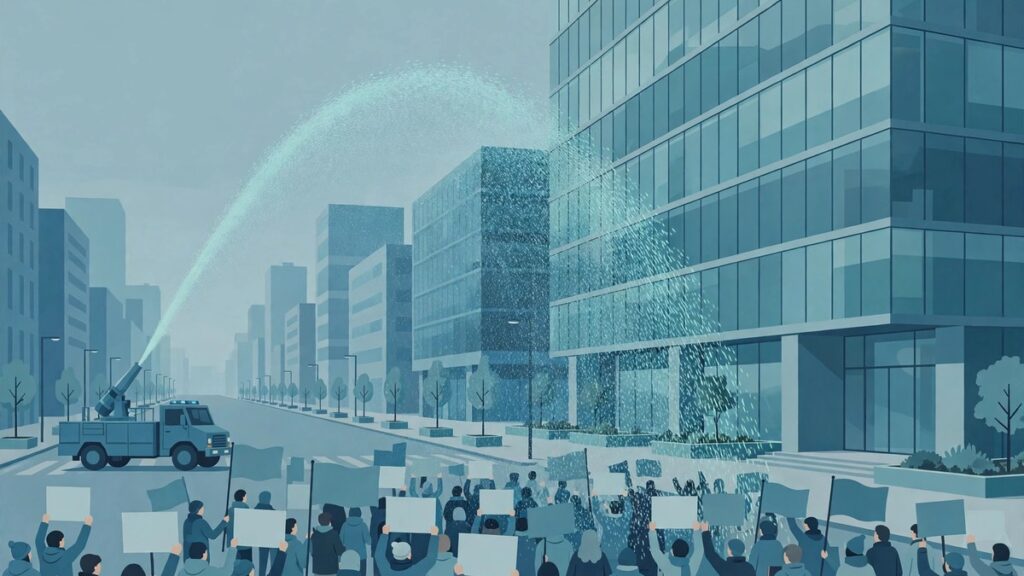
According to Reuters, police in the Indian state of Haryana used a water cannon on 28 November 2026 to disperse activists from the Congress party's youth wing protesting outside Meta's offices in Gurugram. The demonstrators accuse Meta of censoring opposition voices, a charge the company faces in its largest market by users.
The Meta India protest was organised by the Indian Youth Congress, the youth wing of India's main opposition Congress party. Its national president, Uday Bhanu Chib, was photographed reacting as officers sprayed the crowd. The youth wing posted on X that its activists were hit with water cannon and drenched with filthy water, and accused the government of using force against demonstrators demanding freedom of expression.
Police detained a few party supporters during the protest, but they were later released, according to a Reuters witness, and Northland News Radio carried the same Reuters report. The News reported that activists have staged large protests outside Meta offices, accusing the company of acting in the interests of Prime Minister Narendra Modi's Bharatiya Janata Party. Vocemundi noted that the reporting it reviewed included no statement from Haryana police or Indian authorities on the use of the water cannon.
Why it matters
The reason this confrontation matters goes well beyond one afternoon outside one office. India is Meta's largest market by users, which means decisions made about Indian accounts, posts and pages shape the information diet of hundreds of millions of people. When the main opposition party says its voices are being throttled on the country's biggest social platforms, the dispute stops being a moderation argument and becomes a question about who gets heard in the world's largest democracy. That is why a local protest about account removals can quickly become a national political story.
The specific allegation is worth spelling out carefully, because it is the heart of the row. Congress activists say Meta has removed some accounts and posts belonging to party members, and they read that pattern as the company acting in the interests of the ruling Bharatiya Janata Party. Photographs of the protest shared by the youth wing show placards depicting Meta and the BJP as puppeteers, and phone-shaped props carrying the words WITHHELD IN INDIA over Instagram and Facebook logos. The placards are protest theatre, not proof, but they show exactly how the opposition wants the public to understand the issue: as censorship outsourced to a private company.
There is an important distinction between what the protesters allege and what has been established. The reporting so far describes the allegation, the protest and the police response; it does not include a detailed response from Meta to the censorship claim, nor a police account of why the water cannon was used. Vocemundi, reviewing the coverage, pointed out that no statement from Haryana police or Indian authorities appeared in the reports it examined. Readers should treat the censorship charge as an allegation under dispute, not as a settled finding, until Meta or a regulator answers it with specifics.
The policing choice is itself part of the story. Water cannon is a crowd-control tool that photographs dramatically, and that is precisely why both sides care about it. For the police it is a way to clear a street without baton charges or mass arrests; only a few supporters were detained, and they were released. For the protesters it is evidence of the state using force against people demanding freedom of expression, and the claim that the water was filthy turns a tactical decision into a story about contempt. The images of drenched flag-bearers will travel much further than any press release either side issues.
Meta's position in India has been uncomfortable for years, and this protest is the latest squeeze. The company must comply with Indian law, including takedown orders, while insisting its moderation is neutral and applied consistently. Every removal of an opposition post is read by critics as political, and every refusal to remove something is read by the government as defiance. There is no ruling that satisfies both audiences at once, which is why the same argument returns in different forms: account suspensions, withheld content, and now a street protest outside the company's own offices.
Timeline: the confrontation took place on 28 November 2026, when Haryana police used the water cannon outside Meta's Gurugram office and detained a few supporters who were later released. The protest followed earlier large demonstrations by Congress activists outside Meta offices over the same censorship allegations, and the youth wing's posts on X carried the confrontation to a national audience the same day. The Verge also reported the incident on 28 November, citing Reuters, as the story spread from the wire to technology and political coverage.
What happens next will be decided less by the protest itself than by what Meta and the authorities do in its wake. If Meta explains specific removals with evidence, the opposition's broad charge gets harder to sustain; if it stays silent, the allegation fills the vacuum. If the police explain the decision to use the cannon, the force looks procedural; if they do not, it looks political. Either way, the episode shows how platform governance in India is now fought in three places at once: in court filings, in moderation queues, and on the street.
What to watch next
Watch for a response from Meta to the censorship allegation, and for any statement from Haryana police explaining the use of the water cannon. Either statement would change how this story is understood, and the absence of both would itself become part of the story.
Watch also whether the Congress party escalates the campaign with more protests at Meta offices in other Indian cities, and whether regulators or courts pick up the underlying question of how platforms handle opposition content in India.
Frequently asked questions
What happened outside Meta’s offices in India?
On 28 November 2026, police in Haryana used a water cannon to disperse Indian Youth Congress activists protesting outside Meta’s office in Gurugram. The protesters accuse Meta of censoring opposition voices. A few supporters were detained and later released.
Why were Congress activists protesting at Meta?
The activists say Meta removed some accounts and posts belonging to Congress party members, and they allege the company acts in the interests of Prime Minister Narendra Modi’s Bharatiya Janata Party. Meta has not been reported as responding to the specific allegation in the coverage so far.
Where did the protest take place?
Outside Meta’s office in Gurugram, in the northern Indian state of Haryana. Gurugram is part of the National Capital Region around New Delhi and hosts offices of many global technology companies.
Why does this protest matter beyond India?
India is Meta’s largest market by users, so how the company handles Indian political content affects hundreds of millions of people. The case shows how platform moderation disputes can spill from courtrooms and content queues onto the street.


