
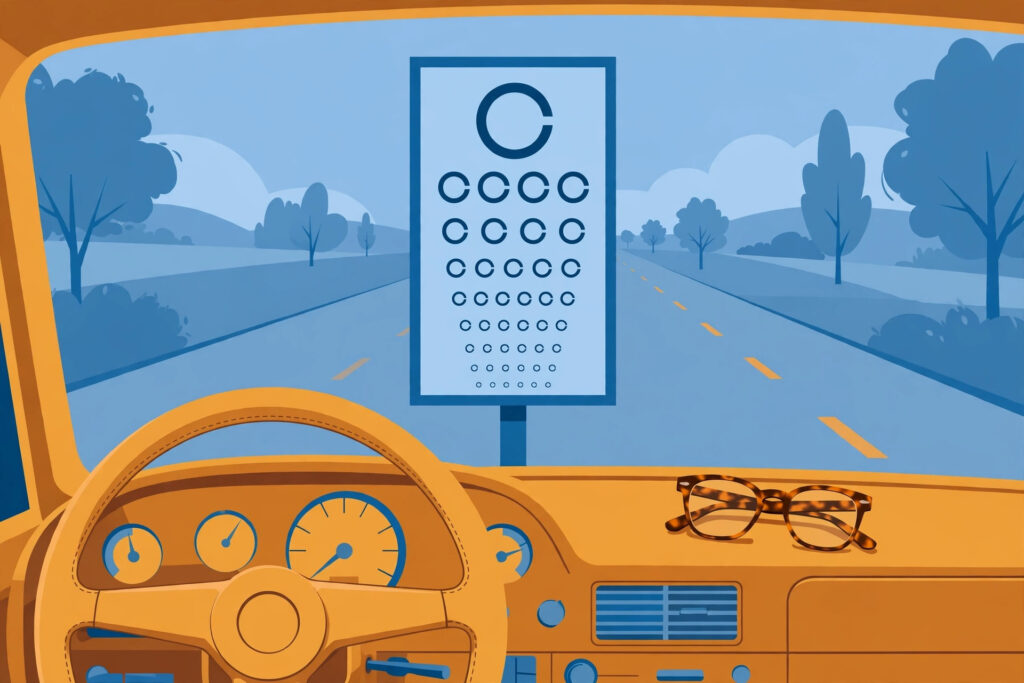
According to Auto Express, drivers over the age of 70 in the UK could soon face a mandatory eye test every three years, with failure meaning the loss of their licence. The plan, part of the government's new Road Safety Strategy, is being finalised, with an announcement expected within weeks, and test results would be shared with the DVLA.
The change would affect around 6.5 million drivers over 70, including 1.6 million aged 80 or older, according to Geo.tv. At present, over-70s renew their licence every three years but only self-certify that their eyesight meets the legal standard, which is being able to read a number plate from 20 metres in good daylight, with glasses or contact lenses if needed.
The push for reform follows a 2025 inquest that found four pedestrians were killed by older drivers who had failed to report deteriorating eyesight to the DVLA. A senior coroner called the current rules unsafe and unfit to meet the needs of society. Geo.tv reports that around 27 percent of drivers killed in road accidents in 2025 were aged over 70, despite accounting for just 15 percent of licence holders.
Why it matters
The striking thing about this proposal is how modest it sounds and how much argument it has generated. A vision test every three years for people over 70 is, on its face, one of the least intrusive safety measures a government can impose. Nobody is being asked to retake a driving test, nobody is being banned by age alone, and the test itself is the same one opticians already perform millions of times a year. Yet the reaction has split between road safety groups who call it overdue and campaigners who call it discriminatory, and that split tells us something important about how Britain argues over age.
The case for change rests on a gap between the rule and reality. The current system asks older drivers to report their own failing eyesight, which means it depends on the people least able to judge their own decline being the most honest about it. The 2025 inquest that triggered this reform showed what happens when that trust breaks down: four pedestrians dead, killed by drivers whose eyesight had deteriorated and who had said nothing. A senior coroner called the rules unsafe, and it is hard to read that inquest and conclude the self-reporting system is working.
The case against, put by Dennis Reed of the campaign group Silver Voices, is that picking an age out of the hat is discriminatory. There is a real point here, and it deserves taking seriously. Vision deteriorates at different rates, and a healthy 75-year-old may see better than an unhealthy 55-year-old. An age-based rule is a blunt instrument, and blunt instruments can feel unfair. But the counter-argument is that blunt instruments are sometimes the only ones that work at scale, and the statistics give the government cover: drivers over 70 are markedly over-represented among those killed on the roads, and the risk rises sharply after 80.
What happens next in practice matters as much as the principle. The Department for Transport says no official decision has been made yet, and it is carefully reviewing consultation results. If the plan goes ahead, the mechanics will need thought: NHS eye tests are free for over-60s but are not designed to test road-safety standards, so ministers are considering whether to expand them. Opticians would need capacity for millions of extra tests, and the DVLA would need a fair process for drivers who fail, including retests and a route back to driving if their vision can be corrected with glasses or treatment.
There is a wider strategy behind this single measure that is worth understanding. The Road Safety Strategy also includes a lower drink-drive limit, tougher sentencing for drink and drug drivers, a minimum learning period for younger drivers, and more mandatory driver-assistance systems in new cars. The stated aim is to cut deaths and serious injuries on British roads by 65 percent before 2035. The eye test for over-70s is one piece of that programme, and it is notable that the government is willing to spend political capital on older voters, a group politicians usually avoid upsetting, to get it.
The deeper question is what kind of country Britain wants to be for its older citizens. Driving is independence: it is the shopping trip, the hospital visit, the grandchild's school play. The Department for Transport's own spokesperson acknowledged this, saying the government recognises the importance of driving for older people's independence while needing to balance it with keeping everyone safe. That balance is the whole argument in one sentence. The AA's president, Edmund King, supports the change, saying regular eye tests are welcome, especially as crash likelihood rises after 70 and markedly after 80. The optometrists' associations agree. The test, in the end, is not about age. It is about whether a driver can see the road.
What to watch next
Watch for the formal announcement in the coming weeks, and for the detail that will decide how the policy actually works: whether cognitive tests are included, how the DVLA will handle failures and appeals, and whether NHS eye tests will be expanded to cover road-safety standards.
Watch too for the political reaction. If the plan survives contact with older voters and their representatives, it will show that road safety can beat age politics. If it is watered down or delayed, the coroner's warning from 2025 will hang over whatever replaces it.
Frequently asked questions
What is being proposed for drivers over 70?
The UK government is finalising plans for mandatory eyesight tests every three years for drivers aged 70 and over. Failing the test, or refusing it, could mean the DVLA revokes the licence.
How many drivers would be affected?
Around 6.5 million drivers over 70, including 1.6 million aged 80 or older, according to Geo.tv. At present they renew their licence every three years but only self-certify their eyesight.
What is the current eyesight rule for drivers?
Drivers must be able to read a number plate from 20 metres in good daylight, with glasses or contact lenses if needed, and must self-report vision conditions to the DVLA. There is no mandatory test after the driving test.
When will the new eye test rule start?
No date has been set. The plans are being finalised as part of the new Road Safety Strategy, with a formal announcement expected within weeks, and the Department for Transport says no official decision has been made yet.


