
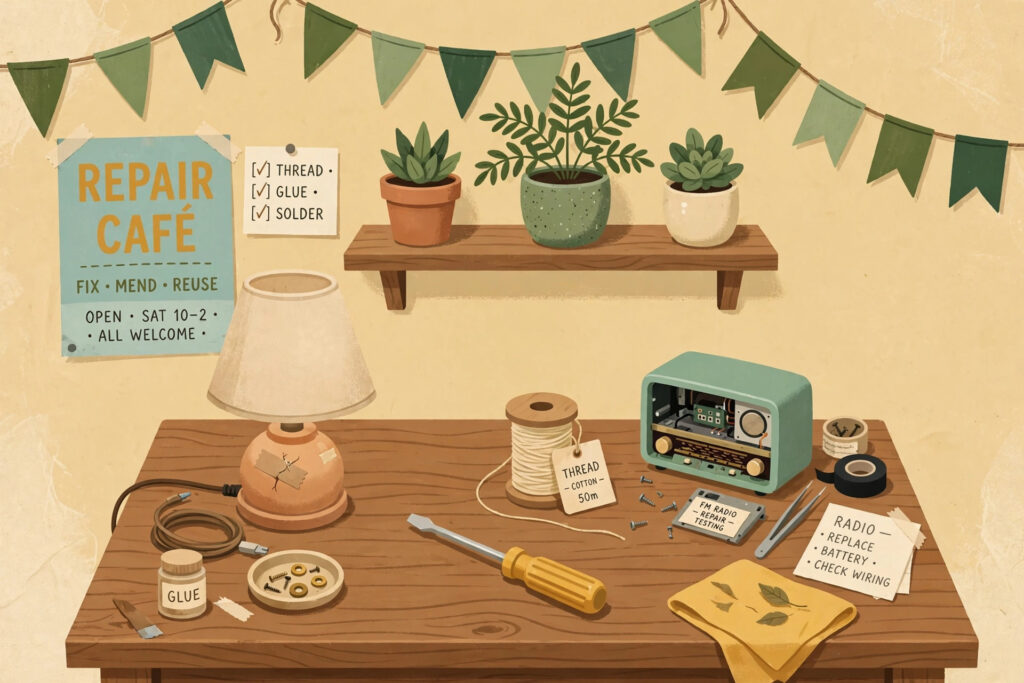
According to Gadget Review, repair cafés are free community workshops where volunteers help neighbours fix broken belongings instead of throwing them away. The idea began in Amsterdam in 2009, when Martine Postma launched the first café, and the Repair Café movement now spans more than 40 countries with 4,000 cafés worldwide.
In Decatur, Georgia, the café meets in a warehouse behind a church parking lot, where volunteers including electricians, tailors, luthiers, carpenters and a knife sharpener help residents with broken lamps, glitching electronics, cracked furniture and dull knives. One visitor, Lilly Pettus, brought a cracked dining room chair her family had owned for decades, and three strangers helped glue and clamp it back together while she learned how the chair was made.
In Atlanta's Collier Heights neighbourhood, where the median household income is roughly 40,000 dollars lower than in Decatur, the motives are more practical. Gale Pines brought a red air fryer that stopped working after dehydrating ginger; she could not afford a new 100-dollar replacement, and a volunteer found a faulty capacitor while another had a spare part. Repair Café International says its network prevented nearly two million pounds of waste in 2025.
Why it matters
The first thing to understand about a repair café is that it is not really about the lamp. It is about the moment when a stranger who knows how a motor works sits down with a stranger who does not, and something gets fixed that would otherwise have gone to landfill. Martine Postma, who founded Repair Café International in the Netherlands, put it sharply: when a product breaks and you have to throw it away, it is very lonely. The café answers that loneliness with company, and with the small, stubborn pleasure of making something work again.
The economics underneath are brutal, and the movement exists because of them. Modern products are often cheaper to replace than to repair, not by accident but by design: manufacturers limit spare parts, lock software, and make devices that cannot be opened without breaking them. A report by the US Federal Trade Commission, titled Nixing the Fix, found that Americans are incentivised to replace products before the end of their useful lives by exactly these tactics. The repair café is a community answer to a market failure, and its volunteers are doing, for free, the work that manufacturers have made unprofitable.
That is also why the movement has become political. In 2023, California, Colorado, Minnesota and New York all passed right-to-repair laws requiring manufacturers to make parts, tools and manuals available, and the European Union passed a similar directive a year later. Postma hopes for more sweeping European change, including a tax on raw materials that would make new products reflect their true cost. The repair café, in this telling, is not a hobby. It is the grassroots wing of a policy fight about who owns the things we buy.
The contrast between the two Georgia cafés in the original report is the most revealing part of the story. In Decatur, visitors bring items with sentimental value, like a chair owned for decades, and the reward is learning and connection. In Collier Heights, where incomes are far lower, visitors bring things they need to keep using, like an air fryer they cannot afford to replace. Gale Pines said it plainly: it is hard to exist, and she does not have a very big support network outside her friends. The same free workshop serves two different needs, and both are real.
The environmental numbers are striking, even allowing for the fact that they come from the movement itself rather than independent auditors. Repair Café International says its cafés prevented nearly two million pounds of waste in 2025, the equivalent of more than 100 fully loaded Boeing 747 aircraft, and cut greenhouse gas emissions equivalent to the energy use of about 1,000 Dutch families. An earlier figure, cited by Gadget Review from the Christian Science Monitor, put the 2023 total at more than 1.4 million pounds diverted from landfill. The trend is upward, and the direction is unmistakable.
But the deepest value of the repair café may be the one that is hardest to measure: the transfer of skill. A volunteer in a green shirt reading I can probably fix that is not just repairing a toaster; they are showing a neighbour that repair is a normal, learnable thing. Lew Lefton, a volunteer quoted in the report, joked that if the world ends, at least he will know how to fix a motor. Behind the joke is a serious point. A society that has forgotten how its objects work is a society that must buy new ones forever, and the repair café is quietly teaching people to remember.
What to watch next
Watch whether right-to-repair laws spread further in the United States and Europe, and whether manufacturers respond by making products genuinely easier to fix or by finding new ways to lock them down. The next round of legislation, and the industry's response to it, will decide whether repair cafés stay a volunteer workaround or become unnecessary.
Watch too for the movement's growth in the United States, where more than 200 community repair programmes already exist. If the model spreads from church basements and warehouses into schools, libraries and workplaces, the repair café could become as ordinary a piece of community infrastructure as the food bank or the farmers market.
Frequently asked questions
What is a repair café?
A repair café is a free community workshop where volunteers with repair skills help neighbours fix broken belongings, from lamps and electronics to furniture, clothing and knives, instead of throwing them away.
How many repair cafés are there?
Repair Café International, founded in the Netherlands, now has a network of 4,000 cafés in more than 40 countries, including a few hundred meetings across the United States.
What can you bring to a repair café?
Almost anything you can carry: broken lamps, glitching electronics, cracked furniture, torn clothing, musical instruments and dull knives are among the items volunteers commonly help with.
Do repair cafés charge for repairs?
No. Volunteers offer their skills free of charge, and visitors usually only pay for any spare parts needed. The idea is to make repairing a normal part of everyday life again.


