
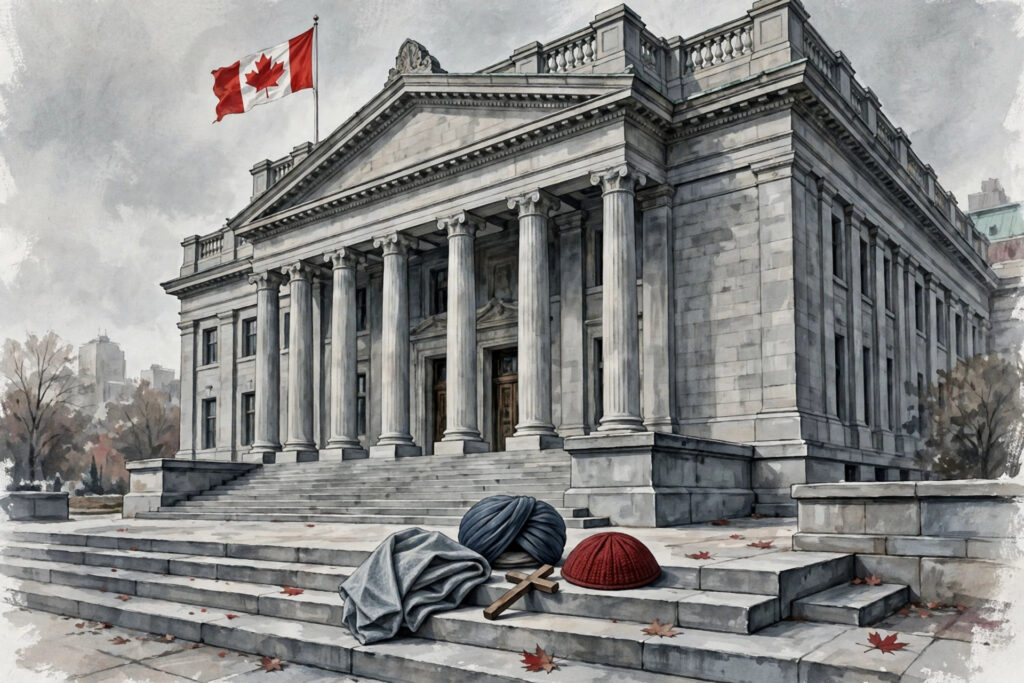
According to Al Jazeera, Canada's Supreme Court on 27 November largely upheld Quebec's secularism law, leaving the ban in place for teachers, police officers and other public employees who wear religious symbols while working, in a landmark ruling that settles a years-long legal battle.
Bill 21 was passed by Quebec's National Assembly on 16 June 2019 by 73 votes to 35, and it bars people in certain positions of authority — judges, police officers, prosecutors, school principals and teachers — from wearing religious symbols while exercising their functions, the Canadian HR Reporter reported. Quebec invoked section 33 of the Charter of Rights and Freedoms, the notwithstanding clause, when it passed the law and renewed it in 2024. The court found Quebec had used the clause lawfully, and that it can be used before a court rules on whether a law violates Charter rights.
The court did strike down one part: the section 8 requirement that members of Quebec's National Assembly exercise their functions with their faces uncovered, because it violates the democratic right to sit in the legislature, which the clause cannot override. The National Council of Canadian Muslims called the ruling a dark day in Canada's constitutional democracy, while Quebec Premier Paul St-Pierre Plamondon welcomed it and Alberta Premier Danielle Smith celebrated it as a win for provincial rights.
Why it matters
The notwithstanding clause is the real subject of this ruling, and the Quebec religious symbols ban was its test case. Section 33 of Canada's Charter of Rights and Freedoms lets a federal or provincial government declare that a law operates even though it violates certain Charter rights, including freedom of religion and equality. The override lasts up to five years and can be renewed. Quebec used it when it passed Bill 21 in 2019 and renewed it in 2024. Until now, the Supreme Court had considered the clause directly only once, in its 1988 decision in Ford v. Quebec. This ruling is therefore the most important statement in nearly forty years on how far a government can go in setting rights aside — and the court, in essence, said a long way.
The ruling's shape, in dates, explains why it took so long and why it matters now. On 16 June 2019, Quebec's National Assembly passed Bill 21 by 73 votes to 35, under the previous Coalition Avenir Québec government. In 2024, Quebec renewed the notwithstanding clause declaration. The Supreme Court heard the appeals over four days in March 2026, with nearly 150 lawyers appearing for the parties and dozens of interveners, including the federal government and five other provinces. On 27 November 2026, the court delivered a decision of more than 500 pages — English Montreal School Board v. Quebec (Attorney General), 2026 SCC 41 — upholding the law almost entirely. Quebec has since widened the restrictions to school support staff and volunteers under Bill 94 and to daycare staff under Bill 9, and its government has said it wants to go further by barring elementary school students from wearing religious symbols.
The court was not united, and the divisions are as significant as the outcome. Chief Justice Richard Wagner, writing for three justices, held that section 33 imposes only formal requirements — an express declaration naming the Charter provisions being overridden, expiring after five years unless renewed — and that courts cannot place additional limits on the override. Four judges, however, said superior courts can still declare that a shielded law infringes Charter rights, even though it would not strike the law down. Only three of the seven would actually have issued one in this case, so none was issued. The gender equality argument, based on section 28 of the Charter, failed 4-3. The minority language education argument, based on section 23, failed 4-2. Four of the seven judges dissented in part.
The human cost is where the ruling's abstractions meet real lives, and even the majority did not look away. Wagner wrote that Bill 21's stigmatizing and deleterious effects on the people affected, most of whom are Muslim women, must not be underestimated. Al Jazeera reported that the law has reshaped lives: people have lost jobs and left Quebec to keep working, and some Muslim women have removed their hijabs at work to keep their jobs. Justices Andromache Karakatsanis and Michelle O'Bonsawin, in partial dissent, wrote that the law puts devout Quebecers in a terrible dilemma — betray their religious convictions or be excluded from public service — and noted reports of more verbal and physical abuse against religious minorities. The trial judge had found that every job application file closed because of Bill 21 at Montreal's French school service centre belonged to a Muslim woman wearing a hijab.
Politically, the ruling is a victory for Quebec and a complication for everyone else. Quebec Premier Paul St-Pierre Plamondon welcomed it as a win for the province's distinct approach to secularism. Alberta Premier Danielle Smith, whose government intervened to defend the clause, celebrated it as a win for provincial rights. The Daily Star reported that Alberta, Ontario and Saskatchewan have all used the same provision in recent years, on issues from transgender policies to ending strikes. The National Council of Canadian Muslims called the ruling a dark day, and its chief executive Stephen Brown warned that the clause, intended as an instrument of last resort, has become an ordinary instrument of government.
The deeper question is what kind of country Canada is becoming when its highest court accepts that a province can bar citizens from public service because of what they wear on their heads. Quebec's answer, which the court accepted, is rooted in its history — the Quiet Revolution, the 2008 Bouchard-Taylor Commission, and a distinct secularism tradition that owes something to France, though Quebec's rules are much narrower. The counter-argument, made by the dissenting judges and the civil liberties groups, is that a right a legislature can suspend by declaration is a right in name only. Both sides claim to defend democracy: one through elected legislatures, the other through courts. This ruling hands the argument, for now, to the legislatures.
What to watch next
Watch whether Quebec pushes further. Its government has said it wants to bar elementary school students from wearing religious symbols, and the override shielding Bill 21 must be renewed by 2029 or the law's protection lapses. Each renewal will be a political fight, and the court's declaration that judges can formally say a shielded law violates rights gives opponents a new, if limited, weapon.
Watch the other provinces too. Alberta, Ontario and Saskatchewan have all used the notwithstanding clause in recent years, and this ruling tells them the court will not add limits beyond the formal requirements. The question now is whether voters, rather than judges, become the check on the clause — and whether Prime Minister Mark Carney's promise never to use it himself holds.
Frequently asked questions
What does Bill 21 ban?
Bill 21 bars people in certain public jobs — teachers, police officers, judges, prosecutors and school principals — from wearing religious symbols such as hijabs, turbans and kippahs at work. It also requires some people to uncover their faces when providing or receiving certain public services.
What is the notwithstanding clause?
It is section 33 of Canada’s Charter of Rights and Freedoms. It lets federal and provincial governments keep a law in force even if it violates certain Charter rights, including freedom of religion and equality. The override lasts up to five years and can be renewed. Quebec used it when it passed Bill 21 in 2019 and renewed it in 2024.
What part of the law did the court strike down?
Only one part: section 8’s requirement that members of Quebec’s National Assembly exercise their functions with their faces uncovered. The court found that violates the democratic right to sit in the legislature, which the notwithstanding clause cannot override. The ban still applies to the justice minister and the Assembly president and vice-president.
What happens next?
Quebec’s government has said it wants to go further by barring elementary school students from wearing religious symbols. The override must be renewed by 2029 or the law’s protection lapses. Other provinces that have used the clause — Alberta, Ontario and Saskatchewan — will watch closely, and Prime Minister Mark Carney said his government is carefully studying the decision.


