
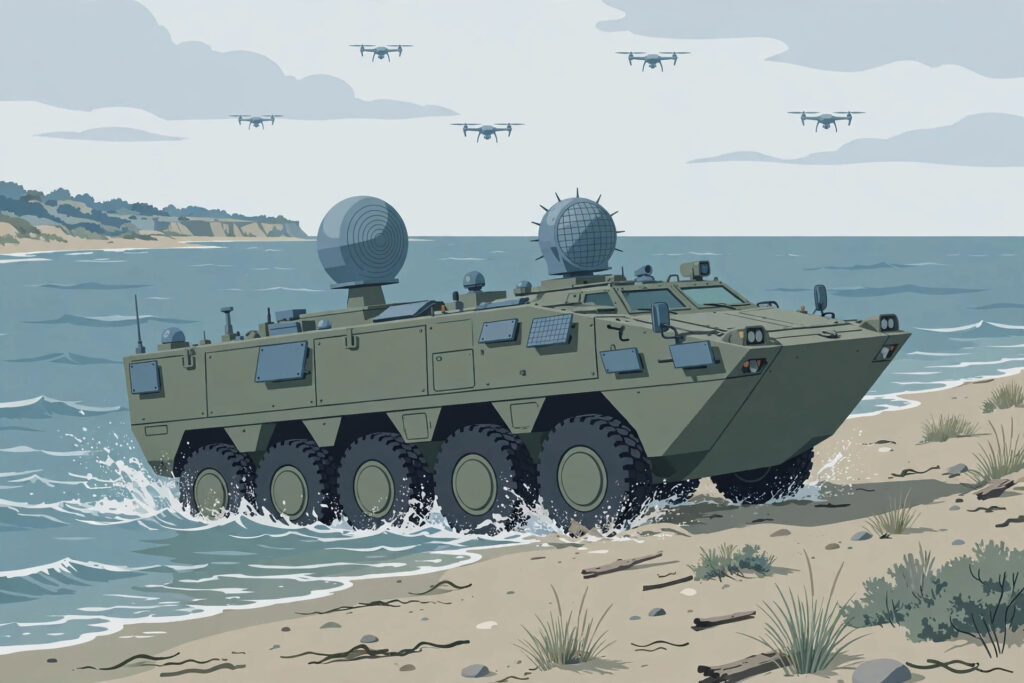
According to Army Recognition, the United States Marine Corps is preparing its Amphibious Combat Vehicles to defend against drone attacks, after awarding Anduril Industries a $15.71 million contract for Pulsar-L electronic warfare jammers to protect the troop carriers that take Marines from ship to shore.
Pulsar-L is a compact, platform-integrated soft-kill system combining sensing and electronic attack against radio-frequency-dependent Group 1 and Group 2 small drones, meaning small aircraft up to 55 pounds. It detects, tracks, identifies and defeats its targets, and can also attack navigation signals. It weighs less than 25 pounds, is about the size of a shoebox, and runs Anduril's Lattice software. The Marine Corps says it provides a 360-degree protective bubble against small-to-medium unmanned threats from up to two kilometres away, while the vehicle is stationary or moving. The system is already used by United States Special Operations Command. Marine Corps Systems Command awarded the sole-source, firm-fixed-price delivery order on 11 September 2026, with the award notice published on 24 September, and first fielding targeted for the first quarter of fiscal 2027, which runs from October through December 2026.
The purchase follows an updated Congressional Research Service assessment published on 6 October 2026, questioning whether the Corps' planned 608 Amphibious Combat Vehicles can survive drones, loitering munitions and anti-tank weapons ashore. The eight-wheeled ACV is replacing the long-serving Assault Amphibious Vehicle as the Marines' principal ship-to-shore armoured transport, and the planned fleet consists of 389 ACV-P personnel carriers, 33 ACV-C command vehicles, 152 ACV-30 gun variants and 34 ACV-R recovery vehicles, each costing about $6 million. The Marines awarded BAE Systems a $230 million contract modification on 30 September 2026 for 32 ACV-R recovery vehicles, and the Navy's fiscal 2027 budget request includes $237 million for ACV upgrades. The vehicle weighs about 35 tons, and the Corps is also contending with saltwater corrosion and the aftermath of 2022 surf-zone mishaps that led to a four-foot breaker-height limit.
Why it matters
The lesson of Ukraine hangs over the story of the Marine Corps ACV, and the Marine Corps is not hiding that fact. In Ukraine, cheap drones carrying cameras and explosives have destroyed armoured vehicles worth millions, and the arithmetic is brutal: a quadcopter costing a few thousand dollars can stalk a 35-ton vehicle and attack through the roof, where armour is thinnest. A .50-calibre machine gun cannot watch every patch of sky, and steel armour and blast seats no longer complete the package. The Corps' own procurement file uses the phrases unusual and compelling need and mission failure and loss of life, which is acquisition language for saying that Marines could die without this equipment. Pulsar-L is the Corps' answer, and the urgency of the purchase reflects how seriously it takes the threat.
The choice of a soft-kill system, rather than a gun or a missile, is itself revealing. Pulsar-L does not shoot drones down; it jams the radio links and navigation signals they depend on, blinding them or forcing them to land. It is cheap per engagement, never runs out of ammunition, and works on the move. But it also has limits the Corps must manage. Fibre-optic drones, which trail a hair-thin control line behind them, cannot be jammed at all, and increasingly autonomous drones can continue toward a target after losing contact with their operator. Jamming also creates problems: every transmission adds to the vehicle's signature, enemy teams can hunt emitters, and friendly drones and communications can suffer inside a poorly managed bubble.
The sole-source nature of the award deserves scrutiny, because it tells a story about defence procurement under pressure. The Marine Corps found only Anduril could meet the requirement on schedule, citing the system's fit within the ACV's cramped space, weight and power allotment, and bought through the Army's existing Anduril contract. The urgent requirement dates to 7 April 2026, a public notice followed on 3 August, and no qualifying competitor emerged. That is defensible when lives are at stake, but it creates a familiar trap: the first buy becomes the installed base, and the installed base writes the sequel. The Corps plans full and open competition for a fiscal 2027 soft-kill counter-drone programme of record, and whether that competition has real teeth will determine whether the taxpayer gets a good deal or a monopoly.
There is a deeper question about whether the amphibious assault itself remains viable in a world of cheap drones. The ACV's job is to carry 13 combat-loaded Marines and a crew of three from a ship to a hostile shore, then keep them mobile and combat-effective once they land. Drones can watch a well deck, follow vehicles leaving the beach, and cue another weapon. A jammer-equipped ACV becomes a moving electronic-warfare node, carrying protection and unwanted attention. The Corps' Force Design concept asks stand-in forces to operate inside an enemy sensing web, and Pulsar-L buys that concept breathing room. But hardware alone cannot preserve the concept: the Corps must fold jammers into tactics, training and emissions discipline, or the equipment becomes a patch.
The wider picture is a Marine Corps rethinking survivability from the ground up. Alongside Pulsar-L, the service has awarded Epirus an $11 million contract for its HAVOC microwave weapon system, selected Allen Control Systems' Bullfrog M240 autonomous weapon for its Light Marine Air Defense Integrated System, and is pursuing active protection systems and overhead armour screening for the ACV. The pattern is layered defence: jamming, microwaves, guns and armour, each covering gaps the others leave. No single system will stop every drone. The question is whether the layers can be integrated fast enough, and cheaply enough, to keep pace with a threat that evolves every few months.
Timeline: on 7 April 2026, the urgent requirement for counter-drone protection for the ACV was formalised. On 3 June 2026, a notice of intent to award a sole-source deal was published. On 11 September 2026, Marine Corps Systems Command awarded Anduril Industries a $15,711,445.50 sole-source delivery order for Pulsar-L systems, with the award notice published on 24 September. On 30 September 2026, BAE Systems received a $230 million contract modification for 32 ACV-R vehicles. On 6 October 2026, the Congressional Research Service published its updated assessment of ACV survivability. First fielding of Pulsar-L is targeted for the first quarter of fiscal 2027.
What to watch next
Watch for the first Pulsar-L installations in early fiscal 2027, and for reports from the units that receive them. How the system performs in training, and whether crews manage the emissions discipline, will matter more than any specification sheet.
Watch the fiscal 2027 programme of record, where full and open competition is planned. Whether rivals can compete, and whether the Corps secures technical data and open interfaces, will determine whether this urgent buy becomes a healthy programme or an expensive dependency.
Frequently asked questions
What is Pulsar-L?
Pulsar-L is Anduril’s compact, platform-integrated soft-kill electronic warfare system. It combines a sensor and a jammer to detect, track, identify and defeat radio-frequency-dependent Group 1 and Group 2 small drones, and can also attack navigation signals. It weighs less than 25 pounds.
Why was the contract sole-source?
The Marine Corps cited an urgent requirement and found only Anduril could meet it on schedule, because Pulsar-L alone fitted the ACV’s space, weight and power allotment. The award was made through the Army’s existing Anduril contract, and open competition is planned for the fiscal 2027 programme of record.
What drones can Pulsar-L stop?
It targets small radio-frequency-dependent drones, including reconnaissance and first-person-view attack drones in Groups 1 and 2, aircraft up to 55 pounds. It cannot jam fibre-optic drones, which use a physical control line, or autonomous drones that continue after losing contact.
Will Pulsar-L alone protect the ACV?
No. It is one layer of a layered defence that also includes guns, microwave systems such as the Epirus HAVOC, the Light Marine Air Defense Integrated System, active protection and armour. The Congressional Research Service has stressed that anti-tank missiles and loitering munitions create separate attack pathways.


