
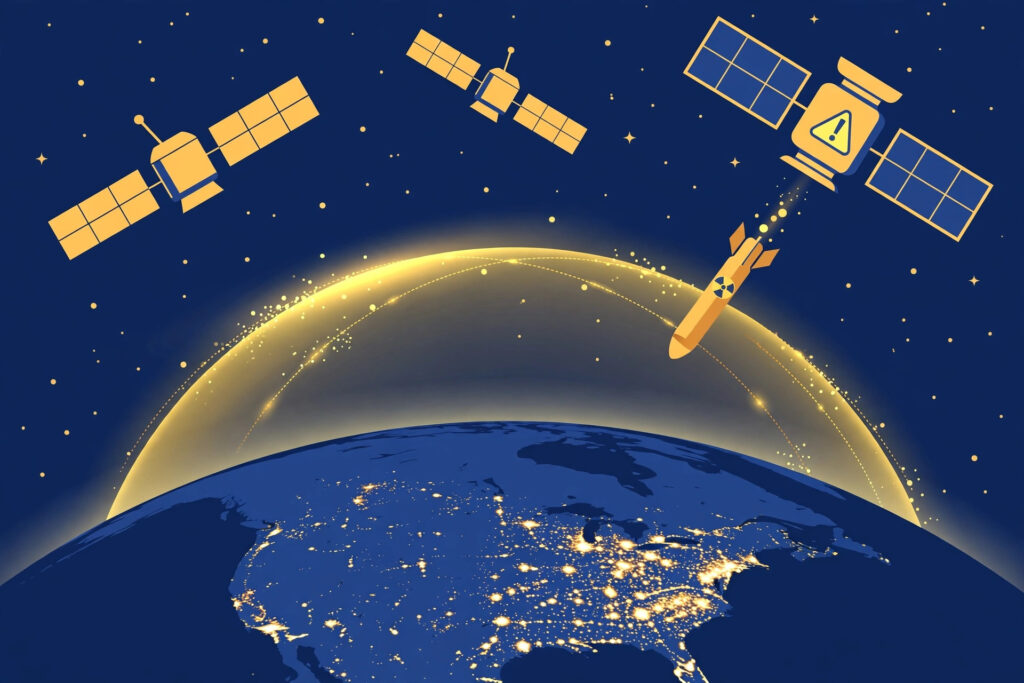
According to Forbes, Russian missiles armed with atomic warheads could soon be lofted into orbit, in a development experts warn could spark a nuclear war stretching from space back to Earth and threaten America's Golden Dome missile shield, as reported this week.
The Munich-based Suddeutsche Zeitung reported this week that Russia is apparently planning to station a nuclear weapon in space this year, and NATO military intelligence leaders are now consulting on the provocation. German Chancellor Friedrich Merz said the news is not new, but it is no less shocking. Spenser Warren, a Harvard-based scholar on Russia's nuclear stockpile, predicts the launch of a flotilla of these orbiting warheads could set off a super-speed contest between the Pentagon, aiming to destroy the missiles immediately, and the Kremlin, pressed to detonate them first. Sending atomic bombs into orbit would create a use-it-or-lose-it scenario, Warren says, because the weapons could hit American nuclear command satellites or missile silos, and American defence planners could fear a Kremlin first strike.
If detonated in low Earth orbit, a hydrogen warhead would take out all satellites in that orbit, Warren predicts, including United States military satellites and SpaceX's Starlink and Starshield. A Russian nuclear blast 500 kilometres up could render these terminals useless in one fell swoop. A thermonuclear device near the International Space Station could obliterate the station and all its astronauts, he adds. A small fleet of Russian spacecraft packed with nuclear explosives might threaten Golden Dome's entire space-based section. Golden Dome could cost up to $2 trillion for the 200,000 interceptors needed to protect the United States against a full-scale Russian nuclear strike, Warren says, and could be vulnerable to an atomic anti-satellite attack while being built. Victoria Samson of the Secure World Foundation says the White House could send commandos to sabotage the weapons before launch, or strike them in orbit at 28,000 kilometres per hour with conventional anti-satellite missiles.
Why it matters
The reason a nuclear weapon in space is different from every other weapon in space is that it cannot be aimed. A conventional anti-satellite weapon destroys one satellite. A nuclear detonation in orbit destroys everything in that orbit, friend and foe alike, military and civilian, American, Chinese, Russian. That indiscriminate quality is what makes the idea alarming, and strategically strange. A weapon that destroys your own satellites along with your enemy's is useful only as a threat, or as a desperate act. That is the logic of Warren's use-it-or-lose-it scenario: once the weapons are in orbit, both sides have an incentive to act first, and decision time shrinks to minutes.
The Golden Dome connection explains why Russia might be doing this. The American missile defence shield, ordered in January 2025 and outlined in May 2025, includes a space-based layer of interceptors against a full-scale nuclear strike. Warren argues that the potential of Golden Dome, or something like it, is a major driver of Russian interest in space nukes. The logic is straightforward: if the United States builds a shield in space, Russia needs a weapon that can break it, and a nuclear detonation is the cheapest way to destroy a large constellation. Whether Golden Dome will ever be built at the scale imagined is a separate question: the White House estimates about $175 billion, against up to $2 trillion for 200,000 interceptors. But the perception of a shield can drive an arms race as surely as the shield itself.
The escalation dynamics are what should worry policymakers most, and the Stockholm International Peace Research Institute has laid them out clearly. Space systems underpin nuclear deterrence: missile early warning, command and control, communications and guidance. Attacking those systems does not just damage hardware; it blinds the systems that tell leaders whether they are under attack, and blinded leaders make worse decisions. The institute warns that alliance dynamics can distort threat perceptions, blur red lines and encourage mirroring, in which defensive moves look like offensive preparations. A nuclear weapon in orbit sits at the centre of that tangle: a threat to satellites, to deterrence and to the treaty system that has kept nuclear weapons out of space for sixty years.
The options available to the United States if a Russian nuclear ASAT is deployed are all unattractive, which is why Samson's suggestions deserve a close look. Sabotaging the weapons before launch would require incontrovertible intelligence of an imminent launch, and would itself be an act of war. Striking the weapons in orbit with conventional anti-satellite missiles is technically possible, Warren notes, since hitting the weapon destroys the systems that trigger the nuclear chain reaction without detonating the warhead, but it would still be a first use of force against a Russian strategic asset. Doing nothing would accept a permanent threat to every satellite in low Earth orbit. There is no clean option: the deployment is designed to create a dilemma with no good answer.
There is also a civilian dimension easily lost in the strategic analysis. Low Earth orbit is not just a military domain. It holds the satellites behind weather forecasting, navigation, banking, shipping and emergency services, and the Starlink constellation that serves millions, including in Ukraine. A nuclear detonation at 500 kilometres would not distinguish between a military satellite and a weather satellite, or an American terminal and a European one. The Chinese space station would be threatened too, along with every other nation's assets there. That is why a Russian space weapon is not only a matter for the Pentagon, but for every country that depends on space, which is every country.
Timeline: in 1962, the Starfish Prime test showed the effects of a nuclear detonation in space on a smaller scale. In 1967, the Outer Space Treaty banned nuclear weapons in orbit. In February 2024, United States officials said Russia was developing a nuclear-related anti-satellite capability; Russia denied the claims. In April 2024, Russia vetoed a United Nations Security Council resolution reaffirming the ban. In January 2025, the United States President ordered the Golden Dome missile defence shield, outlined in May 2025. In June 2025, the Stockholm International Peace Research Institute published its space-nuclear nexus study. This week, Suddeutsche Zeitung reported that Russia is apparently planning to station a nuclear weapon in space this year.
What to watch next
Watch whether Russia launches anything matching this description, and how NATO's military intelligence leaders respond to the consultations under way. A launch would be visible to tracking networks worldwide. Watch too for any American statement about how it would respond, since ambiguity is itself a form of deterrence.
Watch the diplomatic track too. The Security Council has already been blocked once by a Russian veto, but the General Assembly, bilateral channels and the Conference on Disarmament remain open. If the major space powers cannot agree that nuclear weapons have no place in orbit, the treaty system in place since 1967 will be tested as never before.
Frequently asked questions
What is a nuclear ASAT?
A nuclear anti-satellite weapon, or ASAT, is a nuclear warhead placed in orbit to destroy satellites. Unlike a conventional ASAT, which destroys one satellite, a nuclear detonation in low Earth orbit would take out all satellites in that orbit, military and civilian alike.
Is Russia actually putting nuclear weapons in space?
According to Suddeutsche Zeitung, Russia is apparently planning to station a nuclear weapon in space this year. United States officials said in February 2024 that Russia was developing a nuclear-related anti-satellite capability that had not been deployed; Russia denied the claims. No deployment has been confirmed.
What is Golden Dome?
Golden Dome is the United States missile defence shield ordered in January 2025 and outlined in May 2025, including a space-based layer of interceptors. The White House estimated its cost at about $175 billion, while other estimates put it as high as $2 trillion.
What could the United States do about a Russian space weapon?
Space security scholar Victoria Samson says the White House could send special operations forces to sabotage the weapons before launch, or strike them in orbit with conventional anti-satellite missiles. Spenser Warren notes that striking the weapon would destroy its triggering systems without detonating the warhead. Each option risks escalation.


