
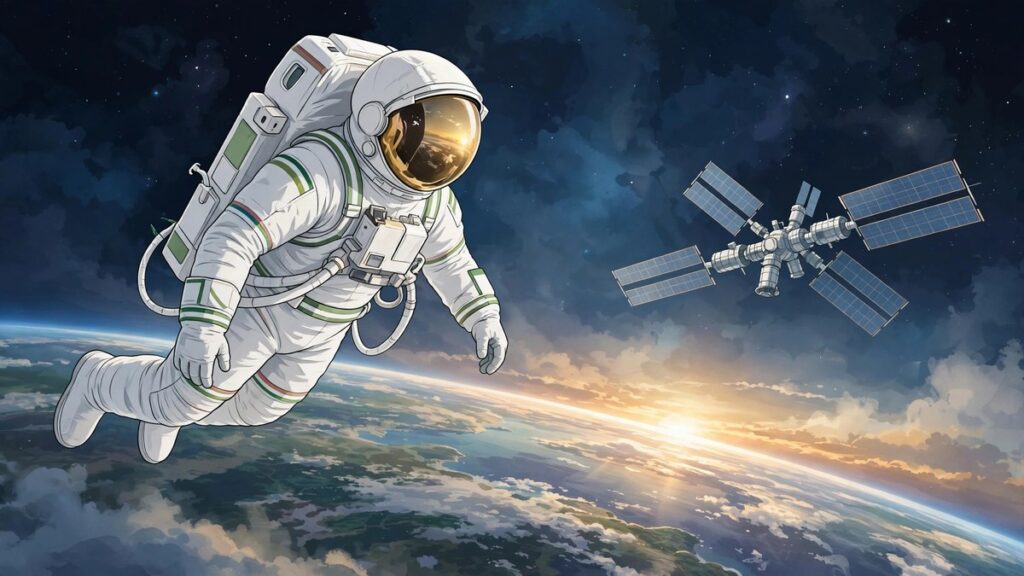
According to Startup Pakistan, Muhammad Zeeshan Ali has become the first Pakistani to reach space, lifting off aboard China's Shenzhou-24 spacecraft and docking with the Tiangong space station about three and a half hours later. The flight makes Ali the first foreign astronaut ever to visit Tiangong.
Ali, a 40-year-old former Pakistan Air Force pilot, flew as a payload specialist alongside commander Tang Hongbo and flight engineer Wu Yi. Space Policy Online reports that Ali and Khurram Daud were chosen as Pakistan's two astronaut candidates in February 2026, trained in China from April, and that China did not announce which of them would fly until the day before launch.
The Shenzhou-24 spacecraft lifted off from the Jiuquan Satellite Launch Center in Inner Mongolia at 8:18 a.m. Beijing time on Wednesday, 25 November, and docked with Tiangong at 11:56 a.m., about three and a half hours later. Ali is expected to spend about a week aboard the station, taking part in scientific experiments, before returning to Earth aboard Shenzhou-23 with two members of the Shenzhou-23 crew.
Before departure, Ali said he was carrying the hopes of his country with him. 'I'm taking the dreams of the Pakistani people into space,' he said at a pre-flight briefing, describing the mission as a reflection of the friendship and close ties between Pakistan and China. China also prepared halal meals for the first Pakistani astronaut and operating manuals in Chinese and English, Startup Pakistan reports.
Why it matters
The flight matters far beyond the symbolism of a first. For Pakistan, a country whose space programme has long lived in the shadow of its larger neighbours, putting a citizen aboard a space station is a proof of capability that no press release can match. It gives SUPARCO, Pakistan's space agency, a human story to build recruitment, funding and public support around, and it puts Pakistan on the short list of nations whose citizens have flown in orbit.
For China, the mission is equally strategic. Tiangong has been a Chinese-only station until now, and opening it to a foreign astronaut turns a national asset into a diplomatic platform. Beijing chose Pakistan, its closest regional partner, for that first invitation, and the message to other countries is plain: cooperation with China's space programme now comes with a seat on orbit. That is a direct challenge to the US-led Artemis coalition, which has spent years assembling its own club of partner nations.
There is a practical side too. Ali's experiments with microalgae and quinoa seeds are the kind of small, focused science that fits a one-week visit, and they point at food security and climate research that matters to both countries. A week is short, but the data from even a short stay helps Pakistan build the research case for a longer presence, and it gives Chinese scientists a partner who brings different research questions to the same laboratory.
Timeline: in February 2025, Pakistan's SUPARCO and the China Manned Space Agency agreed to fly a Pakistani astronaut; in February 2026, Ali and Khurram Daud were chosen as the two candidates; both reported for training in China in April; on 24 November, China confirmed Ali would fly; on 25 November, Shenzhou-24 launched at 8:18 a.m. Beijing time and docked at 11:56 a.m.; Ali is due to return aboard Shenzhou-23 after about a week.
What to watch next
Watch the return flight first. Ali's trip home aboard Shenzhou-23, and the condition of the experiments he brings back, will show whether this was a one-off gesture or the start of a regular exchange. If Pakistan's scientists publish results from the microalgae and quinoa work, the mission gains a scientific afterlife beyond the headlines.
Watch also for the next invitation. If China flies astronauts from other partner countries to Tiangong in 2027, the station becomes a genuine alternative to the International Space Station for nations that have never had a route to orbit, and Pakistan's first flight will be remembered as the one that opened the door.
Frequently asked questions
Who is Pakistan’s first astronaut?
Muhammad Zeeshan Ali, a 40-year-old former Pakistan Air Force pilot who flew to China’s Tiangong space station aboard Shenzhou-24 on 25 November 2026 as a payload specialist.
How long will Zeeshan Ali stay in space?
About a week. He is expected to return to Earth aboard the Shenzhou-23 spacecraft with two members of the Shenzhou-23 crew.
Why is this flight historic?
Ali is the first Pakistani to reach space and the first foreign astronaut ever to visit China’s Tiangong space station, making Pakistan the 55th country to send a citizen into space.
What experiments will he do on Tiangong?
According to reporting on the mission, his work includes experiments with microalgae and quinoa seeds, alongside about 90 experiments run by the full crew.


