
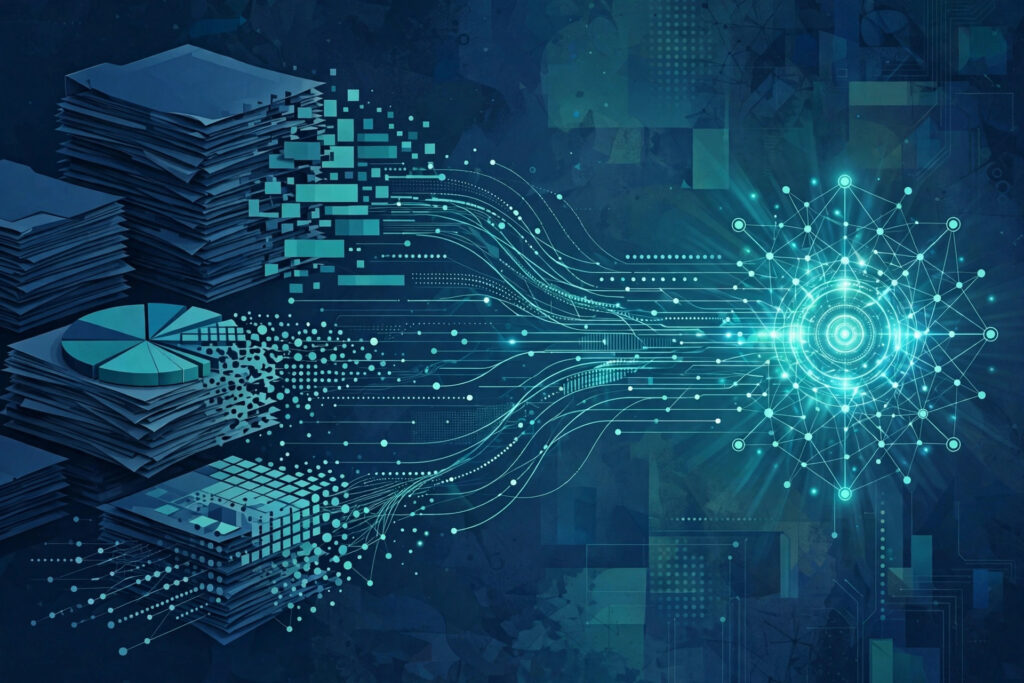
Unsiloed AI has secured $7.5 million in new seed funding, led by Felicis, to help companies turn messy enterprise documents into structured information that AI agents can use reliably. The San Francisco startup, founded by Aman Mishra and Adnan Abbas, will use the money to hire researchers and engineers, expand sales, and build specialist datasets.
Business documents often contain tables, charts and complicated layouts that AI systems struggle to read accurately, and mistakes can be costly in banking, healthcare and law. Unsiloed breaks documents down, extracts information from tables and charts, and converts it into structured data, while showing where each fact came from so staff can check it. The company says pricing starts at one cent per page.
The round also included Y Combinator, Orange Collective and Uncorrelated Ventures, plus angel investors Aarthi Ramamurthy and Beth Turner. Unsiloed already works with customers in finance, legal services and healthcare, including voice AI startup Bolna AI, and its team currently has seven people. In a test on 542 financial documents, the company reported 99.78 percent accuracy across about 84,000 extracted data points, a result that has not been independently verified.
Why does the document problem matter so much for AI agents?
The most useful work in a large company rarely lives in a tidy database. It lives in contracts, loan files, medical records, invoices and scanned forms, where a number in a table only makes sense beside the footnote that qualifies it. Agents that cannot read that material properly will either refuse to act, which makes them useless, or act on a misread figure, which makes them dangerous. Unsiloed is betting that the bottleneck for enterprise AI is not a smarter model but a cleaner feed of facts, and that is a credible reading of where deployments actually stall.
Provenance is the feature that matters most here, more than raw accuracy. A system that points back to the exact page and cell a figure came from gives a human reviewer something to check in seconds, and it gives a compliance team an audit trail. That design choice tells us Unsiloed understands its real customer is not a developer chasing a benchmark, but a bank or law firm that must explain every decision. If agents are to handle regulated work, traceability will become a standard requirement rather than a selling point.
The competitive picture is crowded, and that should temper expectations. Reducto and Unstructured already specialise in this area, Microsoft and Amazon offer their own document tools, and many companies simply use general-purpose models for extraction. Unsiloed claims an edge from dual-stream vision models that handle text and images separately, plus heat-map chunking that concentrates computing power on figures and charts. Those are plausible technical differences, but the test results behind them come from the company's own brief, so buyers will need independent trials before trusting the numbers.
Pricing at one cent per page also reveals the business model. It is cheap enough for a company to try on a single workflow, yet it scales with volume in a way that rewards heavy use. The risk is that document parsing becomes a commodity feature inside larger AI platforms, squeezing standalone vendors on price. Unsiloed's defence is deployment flexibility, including on-premises and air-gapped options for sensitive documents, which large platforms are slower to offer.
What should you watch next?
Watch whether Unsiloed publishes independent benchmark results and names larger customers, because unnamed banks and law firms do not prove a product works at scale. Also watch how quickly Microsoft, Amazon and the big model providers fold similar provenance features into their own offerings, which would test whether a specialist can stay ahead.
Watch hiring and product releases too. With only seven staff, the company must grow its engineering team fast while keeping accuracy high on documents far messier than a controlled test set, and any public failure on a real customer file would damage trust quickly.
Frequently asked questions
What does Unsiloed AI do?
It converts complex business documents, including tables and charts, into structured data that AI agents can use, and shows where each extracted fact came from in the original document.
How much did Unsiloed AI raise?
It raised $7.5 million in seed funding led by Felicis, with Y Combinator, Orange Collective, Uncorrelated Ventures and two angel investors also taking part.
Who uses Unsiloed AI?
The company says its customers include organisations in finance, legal services and healthcare, and it names voice AI startup Bolna AI as one customer.
How accurate is Unsiloed AI?
In a company test on 542 financial documents, it reported 99.78 percent accuracy across about 84,000 data points, but that result has not been independently verified.


