
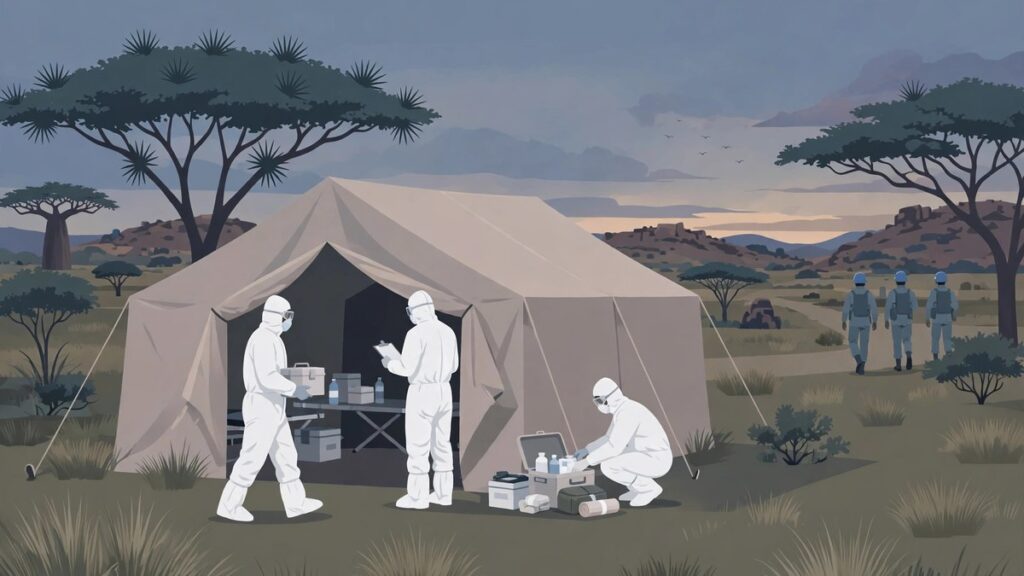
United Nations peacekeepers have evacuated ten health workers trapped for days in a hospital in eastern Democratic Republic of Congo, where fighting disrupted the response to the country's deadliest Ebola outbreak. The workers had sheltered in a maternity ward in Akwe, Ituri province, as Congolese troops clashed with fighters of the Convention for the Popular Revolution, according to Reuters via DailyFoxNews.
The Ebola workers evacuated from Akwe reached Bunia, the provincial capital, on Tuesday after three days caught in crossfire, according to the World Health Organization. The UN mission in Congo, MONUSCO, said it had deployed a mobile operating base on Sunday and reinforced patrols around Akwe, Damas and Mbidjo to bolster civilian protection. The WHO has also moved its team in Mongbwalu, the mining town northwest of Bunia where the outbreak was first detected in May, to Bunia after road access was cut.
The outbreak has infected more than 11,700 people and killed more than 5,700 since it was declared in May, according to government figures, and has reached eight provinces. In neighbouring North Kivu, attacks by another armed group have displaced more than 20,000 people, and health teams have lost track of people who had been in contact with Ebola patients. Blocked roads are making it harder to deliver supplies, transfer patients and carry out safe burials, and some treatment centres are short of staff.
Why it matters
This rescue is a small event inside a much larger collision between war and disease control. Ebola is stopped by speed: finding cases, tracing contacts, isolating patients and burying the dead safely, all of which require health workers to move freely. Fighting does the opposite. It closes roads, empties clinics and turns hospitals into shelters, and every day the response is interrupted is a day the virus spreads unseen. The World Health Organization's decision to move its team from Mongbwalu to Bunia after road access was cut is the clearest sign of that: the response is retreating to where it can still operate, and the areas it leaves behind go dark.
The numbers explain why the stakes are so high. This is the deadliest of Congo's 17 Ebola outbreaks, with more than 11,700 people infected and more than 5,700 killed since it was declared in May, and it has now reached eight provinces. Losing track of contacts, as health teams have in North Kivu after attacks displaced more than 20,000 people, is the specific failure that turns a contained outbreak into a regional one. Contact tracing is unglamorous work, but it is the difference between an outbreak that ends and one that smoulders for years.
The armed group at the centre of the fighting, the Convention for the Popular Revolution, adds a political layer. It is led by Thomas Lubanga, convicted by the International Criminal Court in 2012 of using child soldiers, and it declared a unilateral ceasefire in May that has not held. The group said on Tuesday it was halting its advance on Bunia, and the authorities said the army had pushed the rebels back, but residents said the situation around the city remained tense on Wednesday. A ceasefire that exists on paper while fighting continues on the ground is a familiar pattern in eastern Congo, and health workers cannot plan around it.
There is also a lesson here about the limits of peacekeeping. MONUSCO deployed a mobile operating base on Sunday and reinforced patrols around Akwe, Damas and Mbidjo, and that presence made the evacuation possible. But peacekeepers cannot secure every road or protect every clinic across a province the size of a country. The rescue worked because a small number of people were in one place; the wider response depends on conditions no single mission can guarantee.
The timeline: the Ebola outbreak was declared in May 2026, and the CRP declared a unilateral ceasefire the same month. On Sunday 22 November, MONUSCO deployed a mobile operating base in Ituri. On Tuesday the evacuated workers reached Bunia, and on Wednesday 25 November the mission confirmed the evacuation while the CRP said it was halting its advance on the city.
What to watch next
Watch whether Bunia holds and whether response teams can return to Akwe and Mongbwalu. The next case counts will show whether the interruption allowed the virus to spread undetected, and whether contact tracing in North Kivu can be rebuilt after the displacement.
Frequently asked questions
How many Ebola workers were evacuated?
Ten health workers were evacuated from the hospital in Akwe, Ituri province, with the help of UN peacekeepers from MONUSCO. About a dozen people, including two WHO staff and Congolese health officials, reached Bunia on Tuesday after three days caught in crossfire.
What is the CRP?
The Convention for the Popular Revolution, known as the CRP, is an armed group led by Thomas Lubanga, who was convicted by the International Criminal Court in 2012 of using child soldiers. It declared a unilateral ceasefire in May, but fighting has continued.
How bad is the Ebola outbreak in Congo?
More than 11,700 people have been infected and more than 5,700 have died since the outbreak was declared in May 2026, according to government figures. It has reached eight provinces and is the deadliest of Congo’s 17 Ebola outbreaks.
Why is fighting disrupting the Ebola response?
Fighting closes roads, empties clinics and forces health workers to shelter instead of working. The WHO has had to move teams, blocked roads are making it harder to deliver supplies, transfer patients and carry out safe burials, and some treatment centres are short of staff.


