
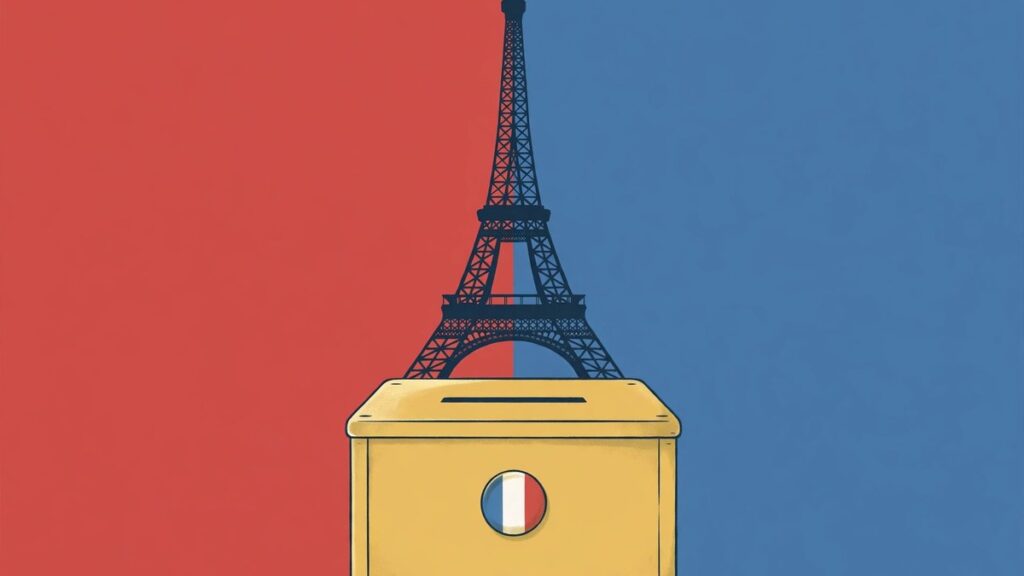
According to the BBC, France's political mainstream faces wipe-out at the French presidential election in April and May 2027 unless it quickly unites behind one candidate. Every poll puts hard-right leader Marine Le Pen and hard-left leader Jean-Luc Melenchon far ahead of every centrist, centre-right and centre-left rival.
Sondagio's first-round polling average as of 19 November 2026 puts Le Pen of the National Rally on 33.2 percent, Melenchon of France Unbowed on 18.6 percent, Edouard Philippe on 12.7 percent and Raphael Glucksmann on 11.7 percent. France votes in the first round on 18 April 2027, with a run-off between the top two on 2 May, and President Emmanuel Macron cannot stand again after two terms, so the race is wide open.
Why it matters
The central paradox of this race is that the mainstream's best hope is also its biggest problem. In theory any centrist or centre-right candidate who reaches the second round should win it, because both Le Pen and Melenchon have more people who oppose them than support them. But to reach that run-off, the centre first has to survive a first round in which its own vote is split between Philippe, Gabriel Attal, Bruno Retailleau and the surprise challenger David Lisnard, mayor of Cannes, whose micro-party Nouvelle Energie has grown to more than 100,000 members. The French presidential election rewards the candidate who can unite a camp, and the centre cannot agree on who that candidate is.
On the left the picture is just as stark. The old Socialist Party and its allies have settled on Raphael Glucksmann, a European Parliament member, but his natural supporters are being pulled into Melenchon's orbit: Green leader Marine Tondelier, a majority of Communist deputies, former Socialist hopeful Benoit Hamon and Francois Ruffin have all backed the France Unbowed leader in recent weeks. Political writer Francois Fressoz told Le Monde that the game in the centre is totally blocked, and the same could be said of the soft left, which has been effectively absorbed by the hard left. Glucksmann is polling around 12 percent, and every point he loses to Melenchon makes a Le Pen-Melenchon run-off more likely.
On the right, the prospects that looked bright only recently have clouded over. Philippe, a former prime minister under Macron, has seen his ratings fall sharply and now sits consistently behind Melenchon in first-round polls. Retailleau, leader of the Republicans, trails at around 5 to 7 percent, and Attal polls at 9 to 10 percent when he runs without Philippe. Lisnard, standing on a platform of less state and lower taxes, has emerged as the man of the hour, but at around 10 percent he is still far from the run-off. More than 30 candidates are in the field, and each new entrant slices the mainstream vote thinner.
What makes this moment historic is not just the polling but what a Le Pen-Melenchon run-off would mean. France's mainstream parties have dominated presidential run-offs for decades, and an election between the hard right and the hard left would be the first time the centre was shut out entirely. Macron is pushing for a broad coalition from social democrats to moderate conservatives to prevent it, and a primary between centrist and right-wing candidates has been proposed. But primaries need time, trust and a willingness to lose gracefully, and the centre has shown little of any of them so far.
What to watch next
Watch whether the centre agrees on a primary or a single candidate before the campaign proper begins. If Philippe, Attal, Retailleau and Lisnard all stay in the race, the maths points to a Le Pen-Melenchon run-off, and the mainstream will have to choose between two candidates it has spent years opposing.
Watch the new entrants too. Five-time Olympic judo champion Teddy Riner entered the race this week, and Eric Zemmour of Reconquete announced his candidacy on 10 November. In a fragmented field, even a small candidacy can tip the balance between second and third place.
Frequently asked questions
When is the French presidential election?
The first round is on 18 April 2027, with a run-off between the top two candidates on 2 May 2027. Emmanuel Macron cannot stand again after two terms.
Who leads the polls for the French presidential election?
Marine Le Pen of the National Rally leads with about 33 percent in first-round polling averages, ahead of Jean-Luc Melenchon on about 19 percent. The leading mainstream candidates, Edouard Philippe and Raphael Glucksmann, poll around 12 percent each.
Why is the mainstream struggling?
The centre, centre-right and centre-left are split between many candidates, including Philippe, Gabriel Attal, Bruno Retailleau and David Lisnard, while Le Pen and Melenchon each dominate their end of the spectrum.
Could a mainstream candidate still win?
Yes, in theory. Both Le Pen and Melenchon have more opponents than supporters, so a mainstream candidate who reached the run-off would be favoured. The problem is reaching the run-off at all.


