
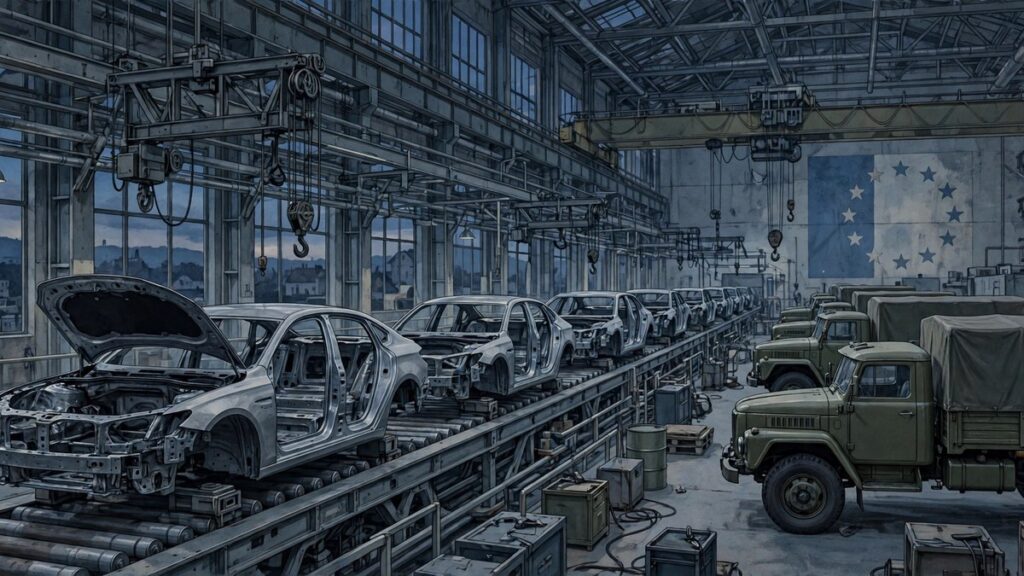
According to the BBC, Europe's car makers are turning to defence work as their core business shrinks, with Ford bidding for a British military vehicle contract, Renault planning military drones with Thales, and Volkswagen selling a German factory for defence use. Output has roughly halved in a decade.
Founder News reports that Jaguar Land Rover has cut 4,000 jobs from its 30,000-strong UK workforce while setting up a dedicated military business unit, and that Ford has teamed with General Dynamics and Ricardo to bid for a UK Ministry of Defence contract covering 9,000 vehicles over five to seven years. Renault has agreed with French defence contractor Thales to produce up to 1,000 military drones a month, and Volkswagen plans to sell an underused German plant to a joint venture involving an Israeli-based defence investor.
Why it matters
The defence pivot is best understood as a capacity problem looking for a customer. European car plants were built for volumes that no longer exist: output has roughly halved over a decade, Chinese rivals have taken share, and the expensive switch to electric vehicles has collided with government sales targets that run ahead of what buyers actually want. A factory running at half capacity loses money every month, so a defence contract that fills the same floor space with the same workers is genuinely attractive, even if the end product is a truck rather than a family car.
What makes this moment different from earlier diversification attempts is the scale and speed of European rearmament. Defence budgets are rising across the continent as governments respond to security fears and reduced reliance on outside military guarantees, and procurement programmes that would once have taken a decade are moving faster. For suppliers, the open letter from executives representing more than 8,600 direct employees, backed by the Confederation of British Metalforming, put it bluntly: the UK automotive supply chain, which supports roughly 183,000 manufacturing jobs, is in the wrong market rather than in terminal decline. Defence is the nearest large market available.
Even so, defence work cannot fix the underlying problem on its own. Military orders are lumpy, political and slow to arrive: Ford's UK bid has no decision yet, Renault's drones still need to reach production, and Volkswagen's factory sale is a single site, not a strategy for the whole group. The electric transition remains the central challenge, because the gap between mandated EV sales and consumer demand does not disappear when a plant also builds military vehicles. Defence can buy time and protect skilled jobs, but it cannot make Europeans buy electric cars they do not yet want at prices they cannot yet afford.
Timeline: in September 2026 the BBC reported car makers across Europe exploring defence production as output fell; Jaguar Land Rover then announced 4,000 job cuts from its 30,000-strong UK workforce; Ford, with General Dynamics and Ricardo, bid for the UK Ministry of Defence contract for 9,000 vehicles; Renault agreed its drone venture with Thales; and Volkswagen moved to sell an underused German factory into a defence joint venture.
What to watch next
Watch the UK Ministry of Defence decision on the 9,000-vehicle contract, because a Ford win would validate the whole pivot and encourage other car makers to bid for similar work. Watch whether Renault's drone line reaches its 1,000-a-month target and whether Volkswagen's factory sale completes, since both will show whether defence customers trust car makers with serious volumes.
Watch electric vehicle sales against government targets through 2027 as well. If demand catches up, the defence pivot becomes a useful side business; if it does not, more plants will face the same choice between closure, sale or conversion, and the political pressure for governments to steer defence work toward car factories will only grow.
Frequently asked questions
Why are European car makers turning to defence work?
Car output has roughly halved in a decade, Chinese competition has intensified, and the electric vehicle transition is expensive, leaving factories with spare capacity. Rising European defence budgets offer large contracts that can fill that capacity.
Which car makers are pursuing military contracts?
Ford is bidding with General Dynamics and Ricardo for a UK Ministry of Defence vehicle contract, Renault has agreed a drone venture with Thales, Volkswagen is selling a German factory for defence use, and Jaguar Land Rover has created a dedicated military business unit.
Will defence contracts save car industry jobs?
They can protect some skilled jobs and keep plants open, but military orders are uncertain and slow, and Jaguar Land Rover has still cut 4,000 jobs. Defence buys time; it does not by itself fix weak demand for electric cars.
What is the biggest problem facing European car makers?
The gap between government electric vehicle sales targets and actual consumer demand, combined with competition from Chinese manufacturers and the high cost of electrification.


