
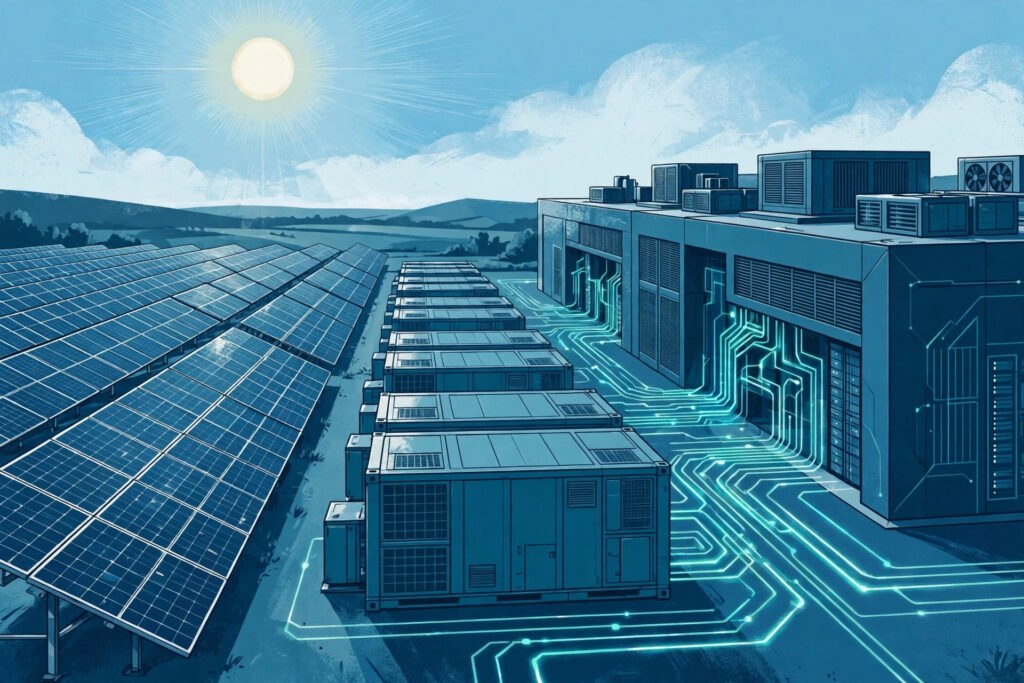
Brook Porter, a partner at G2 Venture Partners, argues that solar power paired with long-duration energy storage is the fastest way to supply electricity to new AI data centers, because factories can build over a terawatt of solar panels a year, against only 60 to 70 gigawatts of gas turbines. His firm led Crusoe's Series C funding round.
Porter told TechCrunch that demand for power is growing faster than people appreciate, and that the United States grid has gone from almost no growth to adding several gigawatts a year. G2 Venture Partners estimates data centre investment will top $4 trillion by the end of the decade. The firm sees two paths for new facilities: small on-grid sites with their own generating capacity, and larger off-grid campuses powered by solar and long-duration storage from companies such as Form Energy and Antora Energy. Going off-grid, Porter said, would let developers avoid grid connection queues and air permits and reach the market far sooner.
Why does the race for AI power come down to factories, not fuel?
Porter's argument is really about manufacturing, not energy. Gas turbines and solar panels both make electricity, but only one of them can be made quickly in enormous numbers. The world can build about 60 to 70 gigawatts of gas turbines a year; it can already build well over a terawatt of solar panels. When a data centre developer needs gigawatts this year rather than in five years, that difference matters more than the price of the fuel. This is the logic of Wright's Law, which Porter cites: make the same thing over and over again, and it gets cheaper and faster to produce. Solar panels and batteries are modular products; gas turbines are bespoke machines. In a race, modular wins.
But the counter-argument, laid out sharply by AInvest's analysis of the same interview, is that Porter is answering the wrong question. A data centre does not buy energy; it buys capacity, the assurance that power will be there at 3 a.m. in January. Solar panels are rated by peak output under full sun, and utility-scale solar in the United States ran at about a 24 percent capacity factor in 2025, against about 59 percent for gas and 91 percent for nuclear. A one-gigawatt campus running flat out uses about 8.76 terawatt-hours a year, and the batteries installed on data centre sites today cover roughly a sixteenth of a single day of that load. Solar is a magnificent energy machine and a mediocre capacity machine, and no honest account can ignore that gap.
The most interesting part of Porter's case is therefore the word off-grid. Going off-grid is not primarily an engineering preference; it is a way to stop asking permission. Grid connections in the United States can take years, and air permits for gas plants are contested and slow. A developer that builds its own solar and storage can, in theory, decide its own fate. That is a powerful pitch in a market where every month of delay means losing customers to a rival. Yet it also shifts the risk: the developer, not the grid, now carries the cost of a cloudy week, a battery failure or a winter with little sun. The AI data centers that bet on this model will need to prove they can keep the lights on when the weather does not cooperate.
There is a broader lesson here for the whole AI buildout. The industry talks constantly about chips, but power may be the harder constraint, and the companies that solve it first will set the pace. If Porter's thesis is right, the winners will be the firms that treat power as a manufacturing problem and build repeatable, modular campuses. If the sceptics are right, the winners will be whoever can secure firm, always-on power, whatever the source. Either way, the debate has moved beyond which fuel is cheapest per megawatt-hour, to which system can actually be built in time.
What should you watch next?
Watch whether long-duration storage moves from a few years away from broad acceptance, as Porter himself concedes, to real deployments at data centre scale, and whether on-site storage duration starts climbing in industry figures. Watch too whether permitting reform shortens grid connections, which would weaken the case for going off-grid, and whether Crusoe's own campuses follow the solar-and-storage path or stick with gas and grid power.
Frequently asked questions
Why does a Crusoe investor favour solar for AI data centers?
Brook Porter of G2 Venture Partners says solar panels can be manufactured far faster than gas turbines, over a terawatt a year against 60 to 70 gigawatts, so solar and storage can bring data centers online sooner.
What is the case against solar for data centers?
Solar produces energy only when the sun shines, with about a 24 percent capacity factor in the US, while data centers need firm power around the clock, and today’s on-site batteries cover only a small fraction of a day’s load.
What does off-grid mean for a data center?
It means building a campus with its own solar and storage power, independent of the grid, which can avoid long connection queues and air permits but leaves the developer carrying the reliability risk.
How big is the AI data center investment wave?
G2 Venture Partners estimates data center investment will top $4 trillion by the end of the decade.


