
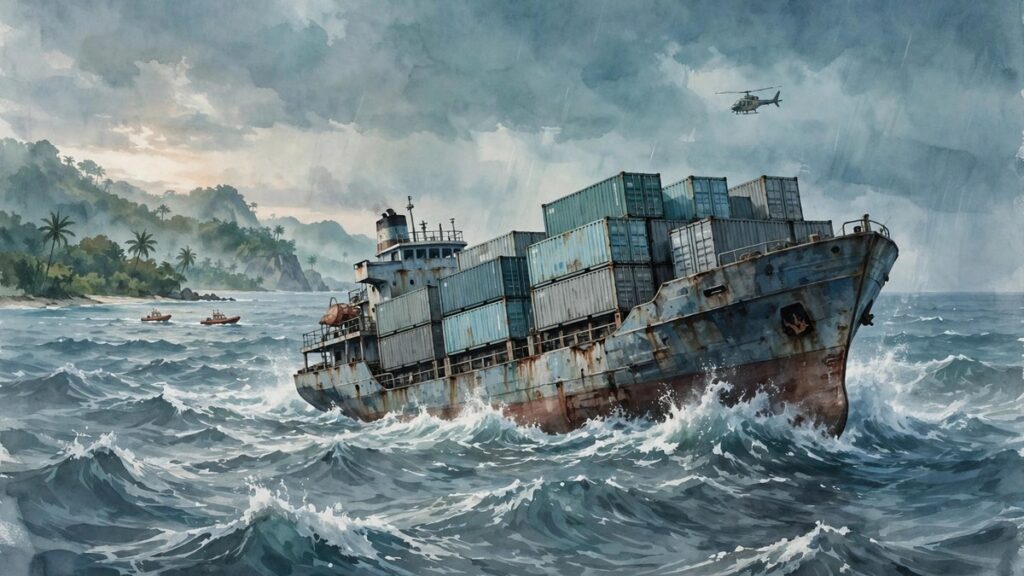
According to Reuters, a Panama-flagged cargo ship carrying 208 containers sank early on Thursday, 26 November 2026, off Cuba's western coast, leaving one crew member dead and three missing. The vessel, Halima, went down about three miles north of Cabañas Bay in Artemisa province, near the port of Mariel, as rescuers searched nearby waters.
SAFETY4SEA reported that the containership, operated by Sidra Line, had 16 Egyptian and Indonesian crew members on board. Cuba's Maritime Administration said rescuers had found 12 crew members alive and recovered the body of a thirteenth, while the search for the remaining three was under way. A government commission has been formed to investigate the cause and coordinate the rescue effort with the ship's owners.
The Maritime Executive reported that Halima was a 5,276-deadweight-tonnage vessel, 99 metres long and built in 1997, with a capacity of 505 twenty-foot equivalent units. Daily Trend reported that the Panama Maritime Authority, the vessel's flag state, has declared the ship a total loss and said no marine pollution had been reported.
Why it matters
The place where Halima went down matters as much as the sinking itself. Cabañas Bay sits a short distance from Mariel, the deep-water container terminal that handles much of what Cuba imports, and the waters north of Artemisa carry a steady stream of regional feeder vessels. A cargo ship sinks in that corridor and it is not a remote-sea accident; it is an accident on the doorstep of the port the island depends on. That is why the Cuban authorities quickly formed a government commission to investigate.
The rescue figures deserve a careful reading, because the first reports did not all agree. Reuters, reporting the Cuban authorities' statement, said 13 of the 16 crew were rescued and one of them later died. The Panama Maritime Authority put it differently: 12 rescued alive, one body recovered, and three missing. Both versions account for all 16 people aboard. The difference is almost certainly timing and counting, not a dispute about the toll: one person is dead and three are missing on every version.
The ship's inspection history is the part of this story that will draw the hardest questions. The Maritime Executive reported that Halima had been cited for deficiencies in each of its last 12 Port State Control inspections dating back to 2023. In May, the vessel was detained for 11 days in Turkey after inspectors found 41 deficiencies, including machinery control and steering gear alarms that were not working, a malfunctioning ballast water management system, problems with the auxiliary engine and a missing speed and distance indicator. A single bad inspection can happen to any ageing vessel. Twelve in a row, ending in a detention, describes a ship regulators kept finding wanting, and thousands of similar ageing feeder vessels work the same kind of routes worldwide.
That question points in several directions at once, and none of them has an answer yet. The flag state, Panama, bears formal responsibility for the vessel's condition, and its maritime authority has opened a safety investigation through its marine accident investigation department, working with the Cuban authorities under the International Maritime Organization's Casualty Investigation Code. The operator, Sidra Line, chartered the vessel and ran the service, and the owners will face questions about maintenance and crewing. What is missing is any public explanation of what happened between the May detention and the sinking, and whether the faults found then were repaired.
The human cost sits inside those institutional questions. Sixteen people were aboard, Egyptians and Indonesians working a regional container run far from home, and the Egyptian Foreign Ministry has confirmed that the sailor who died and two of the three missing crew members are Egyptian, with ten Egyptians injured and nine of them in stable condition. CubaHeadlines reported that Egypt's foreign minister instructed the Egyptian embassy in Havana to stay in close contact with the Cuban authorities and to speed up the repatriation of the dead sailor. Behind the casualty figures are families waiting for news in two countries, and a search whose window narrows with every hour.
Timeline: Halima departed Panama on 17 November with 208 containers aboard, according to CubaHeadlines. Tracking data reviewed by Reuters showed the vessel had loaded containers at a Panamanian port, and The Maritime Executive reported it departing Veracruz in Mexico on 24 November and passing north of Cuba on 26 November. Early on Thursday 26 November, the ship sank about three miles north of Cabañas Bay, near Mariel. The Maritime Administration of Cuba issued its statement the same day. On 28 November the Panama Maritime Authority confirmed the vessel a total loss and said no marine pollution had been reported. Later that day, CubaHeadlines reported that Sidra Line had not ruled out severe weather, adverse sea states or a possible external event such as a drone attack, while stressing that the claim was unconfirmed.
The wider setting explains why this sinking will be felt beyond the families and the shipping companies. Reuters noted that Cuba is going through one of its worst economic crises in decades and relies heavily on maritime imports for food, fuel and other basic goods, which makes its ports and shipping lanes critical arteries for an economy already strained by chronic shortages and recurring blackouts. A feeder ship carrying 208 containers is small beside the giant vessels that dominate world trade, and Reuters described Halima as a 5,276-deadweight-tonnage general cargo ship, small by the standards of large container vessels but typical of regional cargo services. Typical is the point: Cuba's supply lines run on ships like this one, making roughly monthly calls at Mariel, and losing one interrupts a chain with little slack.
What to watch next
Watch the search first. The three missing sailors are the immediate priority, and the coming days will show whether the search area widens, whether weather or sea conditions hamper the effort, and whether any further survivors or bodies are found. The families of the Egyptian and Indonesian crew will be watching for news of repatriation and for the injured survivors' recovery.
Watch the investigation next, and treat early claims with care. Cuba's commission and Panama's marine accident investigators will need to establish whether weather, a mechanical failure linked to the ship's long inspection record, or something else caused the sinking, and the operator's unconfirmed suggestion of a possible drone attack will need evidence. Watch also for what happens to the 208 containers and the wreck, and for any sign of pollution near Mariel.
Frequently asked questions
What happened to the cargo ship off Cuba?
The Panama-flagged containership Halima sank early on Thursday 26 November 2026, about three miles (5 km) north of Cabañas Bay in Artemisa province, near Cuba’s main container port of Mariel. One crew member died, three remain missing, and the rest of the 16 crew were rescued. The cause has not yet been established.
Who was on board the Halima?
Sixteen crew members were aboard, Egyptians and Indonesians. Thirteen were rescued according to the Cuban authorities, although one later died; the Panama Maritime Authority counted 12 rescued alive and one body recovered. The Egyptian Foreign Ministry said the dead sailor and two of the missing crew are Egyptian, and ten Egyptians were injured.
Why do reports differ on how many crew were rescued?
The two counts describe the same toll in different ways. The Cuban account counts the sailor who later died among the 13 rescued, while the Panamanian account counts him as the one dead and 12 as rescued alive. Both agree that one person died, three are missing and all 16 are accounted for.
What caused the Halima to sink?
No cause has been confirmed. The operator, Sidra Line, has said investigations are looking at severe weather, adverse sea states and a possible external event such as a drone attack, but Cuban authorities and maritime publications have not confirmed that claim. The ship’s long record of inspection deficiencies will also be examined.
What happens next?
Cuba’s Maritime Administration is leading the search for the three missing sailors, a government commission is investigating the sinking, and Panama’s marine accident investigation department is coordinating a safety investigation under the International Maritime Organization’s Casualty Investigation Code. No marine pollution had been reported.


