
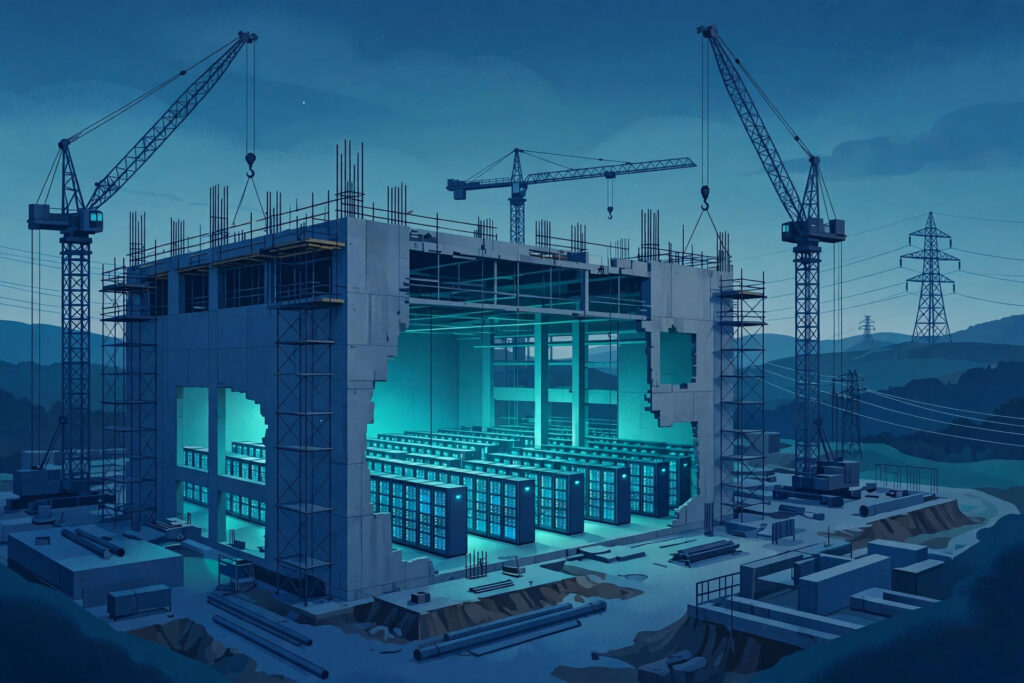
Nvidia will no longer backstop an AI data center until the building is nearly finished, and that shift is squeezing the neoclouds that rent out GPU capacity. With construction delays mounting and borrowing costs rising, developers now need land, power and a finished shell before they can count on the chips that make a project bankable.
TechCrunch's Equity podcast, in an episode published on 25 November 2026, spoke to Anita Verma-Lallian of Arizona Land Consulting, whose firm assembles data center sites for developers, hyperscalers, AI labs and neoclouds. She described a market where community opposition, state-level restrictions and slow grid connections are making some locations much harder to build in than others. Investor Chamath Palihapitiya, a partner of hers, has been predicting a shakeout in the sector.
The podcast also noted that utilities are asking large customers such as TSMC to help pay for the power infrastructure new sites need, and that AI labs and hyperscalers may increasingly build their own facilities rather than renting from neoclouds. Nvidia's own disclosures underline the change: its neocloud support only takes effect once a project is financed, built, running and accepted.
Why does Nvidia's tougher stance matter?
The real story here is a transfer of risk. For the past two years, a neocloud could win an allocation of Nvidia chips, use that allocation to raise debt, and use the debt to build the data center. That circular logic worked while everyone believed the chipmaker stood behind the project. Once Nvidia says its backing only begins when the building is finished, the circle breaks, and the developer, the lender and ultimately the customer carry the construction risk instead. That is why the phrase doing the rounds in the industry, land, power and shell, matters so much: it is the new checklist a project must satisfy before the most valuable input, the chips, is even on the table.
This changes who can compete. A hyperscaler with a strong balance sheet can fund land, grid connections and construction from its own cash and wait out a two-year delay for a transformer. A smaller neocloud cannot, because it pays interest every month while earning nothing from a half-built site. Borrowing was already getting harder for these companies for about a year before the latest turmoil, and the numbers now circulating suggest distressed debt yields of 14 to 16 percent for delayed projects. The likely result is a split market: a few well-funded operators survive and pick up distressed sites cheaply in a 2027 shakeout, while speculative projects that exist mainly as announcements quietly disappear. Industry surveys already suggest that between a fifth and half of announced but unstarted capacity may never be built.
There is also a physical bottleneck that no amount of finance can wish away. Grid power was the delay cited most often by people working on these projects, ahead of permitting, construction problems and late electrical equipment. A large transformer can now take two years or more to arrive, and in one reported case a utility's estimate for connecting a Northern California campus stretched from 24 months to ten years once work began. That is a structural constraint on the whole AI buildout, not a temporary hiccup, and it explains why utilities are asking their biggest customers to help fund new infrastructure. Power, not chips, is increasingly the scarce resource.
For the people who actually use AI, the consequence is subtler but real. If capacity is built more slowly and by fewer, larger operators, the price and availability of compute will depend more on who controls finished buildings and grid connections, and less on who has the cleverest pitch. Microsoft has already tightened oversight of neocloud partners including Nebius, IREN and Nscale after delivery delays, according to a Bloomberg report, and is reconsidering further third-party deals. Developers who rent capacity through a long chain of intermediaries may find that when supply is tight, the party closest to the hardware decides who gets served first. Owning or contracting finished capacity directly, and having a second provider ready, is becoming the prudent strategy rather than an extravagance.
What should you watch next?
Watch whether Nvidia's selectivity hardens into a formal policy, and whether more neoclouds disclose delays or renegotiated timelines in their next earnings reports. The first distressed sale of a half-built AI campus, and the price it fetches, will tell the market more than any forecast about how deep the shakeout runs.
Watch the power side too. Grid connection queues, transformer lead times and state-level votes on data center limits will shape where the next wave of AI data centers can actually be built, and whether hyperscalers keep building themselves or return to renting once the shakeout clears.
Frequently asked questions
What is a neocloud?
A neocloud is a newer cloud provider that specialises in renting out GPU capacity for AI workloads, often building data centers specifically to host Nvidia chips for AI labs and developers.
What does land, power and shell mean?
It means a data center project must have secured land, a grid power connection and a finished building shell before Nvidia will back it. Having all three is now seen as the key advantage for developers.
Why are AI data centers delayed?
The main causes reported are slow grid connections, shortages of equipment such as large transformers, permitting and community opposition, construction problems and more expensive borrowing.
What might a 2027 shakeout look like?
Analysts and investors expect some speculative projects to fail and well-funded operators to buy distressed sites cheaply, leaving fewer, larger providers controlling finished AI capacity.


