
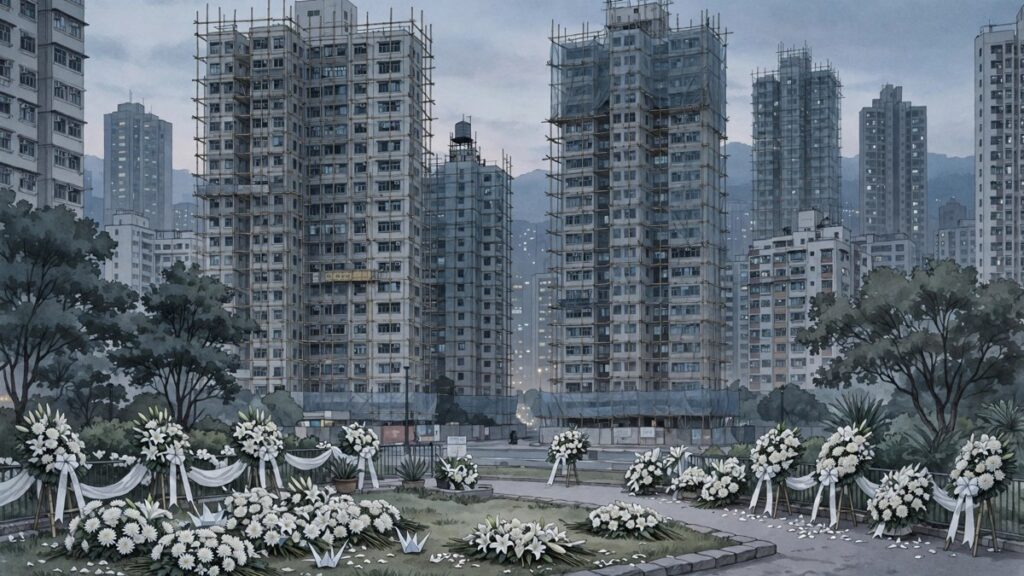
According to the Associated Press, a year after Hong Kong's deadliest fire in decades killed 168 people at Wang Fuk Court in Tai Po, survivors and victims' families are still waiting for justice, even though two building companies have been charged and government departments were found at fault.
The Hong Kong fire engulfed seven high-rise apartment blocks on 26 November 2025, during a renovation of the Wang Fuk Court estate that was meant to improve the homes. The BBC reported that a year after one of Hong Kong's deadliest fires, families left behind are still waiting for justice. An official investigation blamed the fire and the high casualties on substandard materials, deception in the building maintenance project and inadequate regulatory oversight.
Evidence showed the fire was likely caused by a cigarette that ignited paper on the flat roof outside two first-level apartments of Wang Cheong House, and non-fire-retardant scaffolding nets and canvases helped the flames spread rapidly. Foam boards used to cover apartment windows melted when heated and produced burning droplets, while smoke infiltrated escape routes after staircase windows were replaced with panels or wooden boards, and the buildings' fire alarm system had been shut down. Most of the deaths were caused by smoke inhalation.
Why it matters
The Hong Kong fire is a story about a renovation that became a trap, and the investigation report's phrase, a perfect storm, captures how many separate failures had to line up. Residents had expressed concerns about fire hazards during the renovation before the blaze, yet their worst fears became reality. A cigarette, paper, non-fire-retardant nets, foam boards, blocked escape routes and a silenced alarm each played a part, and removing any one of them might have changed the outcome. That is what makes the tragedy so hard to accept for the families: it was not a single accident but a chain of decisions, each of which looked small on its own.
The report found that Will Power Architects Company, the consultant for the maintenance project, and Prestige Construction and Engineering Company, the main contractor, cut corners and were the main culprits. Prestige procured non-fire-retardant scaffolding nets and failed to curb workers' smoking, while Will Power did not step in, and a month before the fire Will Power warned Prestige about an upcoming government inspection, after which the contractor urgently ordered fire-retardant nets to replace those at the bottom of the scaffolding before the check. The investigating committee also found the maintenance project bore the hallmarks of bid-rigging and anticompetitive conduct, and that multiple registered contractors and professionals did no substantive work and signed statutory forms in return for a fee. In June, police and anti-corruption authorities charged Will Power, Prestige and seven people, including the registered inspector, with offences such as manslaughter and conspiracy to defraud.
Government agencies were also blamed, and that part of the report matters most for preventing the next fire. The committee identified deficiencies in the Housing Bureau's independent checking unit, the Buildings Department, the Fire Services Department and the Labour Department, including a lack of proper investigations into foam boards and the fire-retardancy of scaffolding nets, and ineffective handling of concerns about workers' smoking. The report said the regulator's reliance on the good faith of the regulated parties left obvious fire hazards uninvestigated, and that different departments passed the ball to others instead of working together. The independent checking unit did not verify the authenticity of a certificate on the fire-retardancy of the nets in 2024, and only found out it was not legitimate after the fire.
There is a timeline that shows how accountability has moved, and how slowly. The fire tore through Wang Fuk Court on 26 November 2025, killing 168 people and displacing thousands. In June 2026, police and anti-corruption authorities charged the two companies and seven people. On 29 October 2026, the independent committee set up by Hong Kong Chief Executive John Lee published its report finding wide-ranging regulatory failures across four government bodies; that day Lee and senior officials formally apologised, the Housing Secretary later stepped down, and the authorities arrested 35 people in connection with the fire and possible corruption. On 26 November 2026, residents marked the first anniversary by laying flowers and praying near the blackened towers.
The anniversary itself has become a second story, about who is allowed to grieve in public. Human Rights Watch said the Hong Kong government should ensure meaningful accountability and end its suppression of peaceful criticism, and reported that police made inquiries with Catholic churches planning memorial masses, that a group working with migrant workers who survived the fire cancelled a book launch and drama event, and that an online news platform said it would remove videos featuring interviews with survivors. The government held no official ceremony and said it would not organise one, while allowing lawful commemorations. When a disaster becomes a subject that people are afraid to discuss, the lessons of the investigation are harder to learn, and that is a risk in itself.
What to watch next
Watch the prosecution proceedings against Will Power, Prestige and the other defendants, which are still ongoing, and the three-month investigation into whether government employees committed any dereliction of duty. Convictions, acquittals or long delays will each send a different message about whether the system that failed Wang Fuk Court can hold itself to account.
Watch what happens to the site and to the survivors' resettlement. An official said in February that the administration was inclined to dismantle the seven buildings after buying homeownership rights from former residents, with the site possibly becoming a park or community facilities, but no detailed plan has been announced. Until that plan appears, thousands of displaced people remain in temporary housing.
Frequently asked questions
How many people died in the Hong Kong fire?
168 people were killed when the fire engulfed seven high-rise apartment blocks at Wang Fuk Court in Tai Po on 26 November 2025. It was Hong Kong’s deadliest fire in decades, with a toll more than double that of the 2017 Grenfell Tower fire in London.
What caused the Hong Kong fire to spread so fast?
Evidence showed it was likely caused by a cigarette igniting paper, and non-fire-retardant scaffolding nets, foam boards over windows, and smoke entering escape routes helped it spread. The buildings’ fire alarm system had been shut down, and most deaths were caused by smoke inhalation.
Who was blamed for the fire?
A judge-led investigation blamed substandard materials, deception in the maintenance project and inadequate regulatory oversight. It named the consultant Will Power and contractor Prestige as the main culprits, and found failings in four government departments.
What happened after the investigation report?
The report was published on 29 October 2026. Hong Kong leader John Lee apologised, the Housing Secretary stepped down, and 35 people were arrested in connection with the fire and possible corruption. Prosecutions are still ongoing.


