
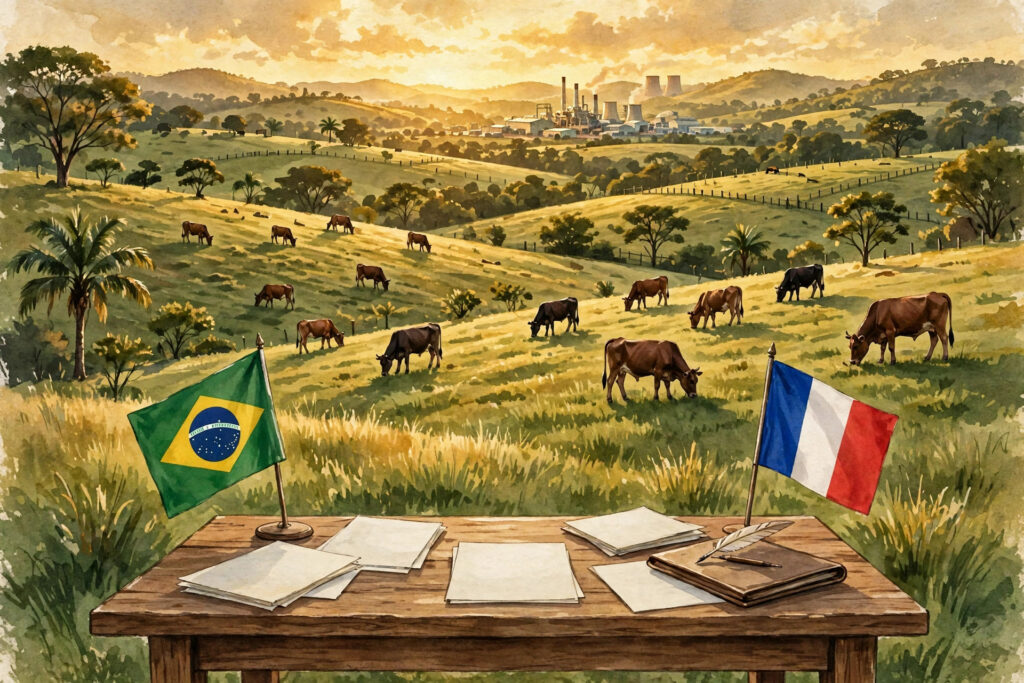
According to PlusNews, Brazil's government on Thursday condemned French President Emmanuel Macron for describing Brazilian meat as 'doped', calling his remarks misinformation that contradicts scientific evidence on the country's animal protein production. The row follows the European Union's suspension of Brazilian animal product imports, which began in September.
Macron made the remark on Wednesday, 25 November, during a meeting with farming union representatives at the Élysée Palace, where he said he was proud of the fight to defend the French meat sector after last year's signing of the EU-Mercosur trade agreement. He said the meat from Mercosur countries, especially Brazil, had not respected European rules and had ultimately been banned. Brazil's agriculture ministry responded that it lamented the president's statements, calling them misinformation that contradicts widely available technical and scientific evidence on Brazilian animal protein production.
The dispute sits on top of the Brazilian meat ban, a European Union ban on many Brazilian animal products that began on 3 September, imposed because the bloc said Brazil had not given sufficient guarantees that prohibited antimicrobials were not used in farming. Brazil points to a European Commission mission that visited between 24 August and 4 September and a report dated 28 September that it says found Brazilian poultry and beekeeping controls met EU requirements. The EU committee that reviews the measures is due to meet on 7-8 December to consider restoring authorisation for poultry and honey. Brazil exported meat worth 1.84 billion dollars to the EU in 2025, according to its agriculture ministry, and its meat reaches 177 markets worldwide.
Why it matters
A single word is doing a lot of work in this dispute. By calling Brazilian meat 'doped', Macron moved the argument from food safety rules to cheating, and cheating is a charge that sticks in a way that a technical disagreement about antimicrobial controls does not. Brazil's response was framed in the same register: its government called the remark misinformation and said it contradicts the technical and scientific evidence on Brazilian animal protein production. Both sides know that the public argument matters as much as the committee procedure, because whoever wins the language wins the politics of the ban.
Macron's audience explains a great deal. He was speaking to representatives of French farming unions at the Élysée Palace, a constituency that has fought the EU-Mercosur trade agreement from the start and sees Brazilian beef as a direct threat to French producers. Saying he was proud of the fight to defend the French meat sector, and celebrating the ban as a victory, was a message to those farmers as much as it was a statement about Brazil. Trade disputes are rarely only about trade, and this one is also about a French president showing his farmers that their anger has been heard.
That does not mean the underlying issue is invented. Antimicrobial use in farming is a genuine global health concern, because overuse of antibiotics in animals can contribute to drug-resistant bacteria that threaten human medicine. The European Union says it suspended Brazilian animal products because Brazil had not provided sufficient guarantees that prohibited antimicrobials were not used, and it removed Brazil from its list of compliant states in May. Brazil's case is that its controls are rigorous and that a European Commission mission and a September report support it. The question the December committee meeting must answer is a technical one, even if the politics around it are loud.
Brazil's defence rests on scale and record. The country is the world's largest producer and exporter of beef, it has supplied animal protein to the European Union for decades, and its meat reaches 177 markets under what it describes as strict quality protocols. It points to a recent European audit of its poultry and beekeeping sectors, and to environmental rules that include a legal obligation to conserve native vegetation on up to 80 percent of rural properties. The argument is that a country with that record does not deserve to be described as a source of 'doped' meat, and that the ban is political rather than scientific.
The money at stake sharpens the argument on both sides. Brazil exported more than 92,000 tonnes of beef products to the European Union in 2025, worth more than 713 million euros, and its agriculture ministry puts total meat exports to the EU at 1.84 billion dollars in the same year. For Brazilian producers, the suspension cuts off a large and lucrative market. For French farmers, Brazilian beef arriving at European ports is competition they cannot match on price. That is why the dispute keeps returning to the same question: is the ban protecting European consumers, or protecting European farmers?
The wider significance goes beyond beef. If sanitary and health rules can be used to block imports from a major trading partner, every exporter has reason to worry about where the line sits between legitimate protection and protectionism, and Brazil has already warned that using such measures as trade weapons would violate World Trade Organization rules. The Mercosur agreement itself is caught in the middle: it was signed last year, it is meant to open trade between South America and Europe, and it is now the backdrop to a public row between the leaders of two of its most important countries. How the December review goes will say a lot about whether the agreement can survive its own politics.
What to watch next
The date to watch is 7-8 December, when the EU's Committee on Plants, Animals, Food and Feed meets to consider restoring Brazil's authorisation for poultry and honey. A partial restoration would ease the dispute without settling it, while a refusal would deepen it and push Brazil closer to formal trade action. Either way, the decision will be read in Brasília and Paris as a verdict on the science, not just the politics.
Watch also whether Brazil follows through on its warning that it will use all available legal and commercial resources to protect its producers, and whether Macron repeats or softens the 'doped' remark. The two governments have both stressed that their partnership matters, but the language of the last few days suggests that neither side is ready to back down first.
Frequently asked questions
What exactly did Emmanuel Macron say?
Speaking to French farming union representatives at the Élysée Palace on 25 November, Macron said he was proud of the fight to defend the French meat sector and described meat from Mercosur countries, especially Brazil, as ‘doped’, saying it had arrived at European ports without complying with European rules and had ultimately been banned.
Why did the EU ban Brazilian animal products?
The ban, which began on 3 September, covers many products of animal origin from Brazil. The EU said Brazil had not provided sufficient guarantees that prohibited antimicrobial substances were not used in production, and it removed Brazil from its list of states considered compliant with EU rules on antibiotic use in cattle farming in May.
How important is the EU market for Brazilian meat?
Brazil is the world’s largest producer and exporter of beef, and it exported more than 92,000 tonnes of beef products to the EU in 2025, worth more than 713 million euros. Its agriculture ministry puts total meat exports to the EU at 1.84 billion dollars in 2025, and Brazilian meat reaches 177 markets worldwide.
What happens next?
The EU’s Committee on Plants, Animals, Food and Feed is due to meet on 7-8 December to consider restoring Brazil’s authorisation for poultry and honey. Brazil has said it may take legal and commercial measures to defend its exporters if the suspension continues.


