
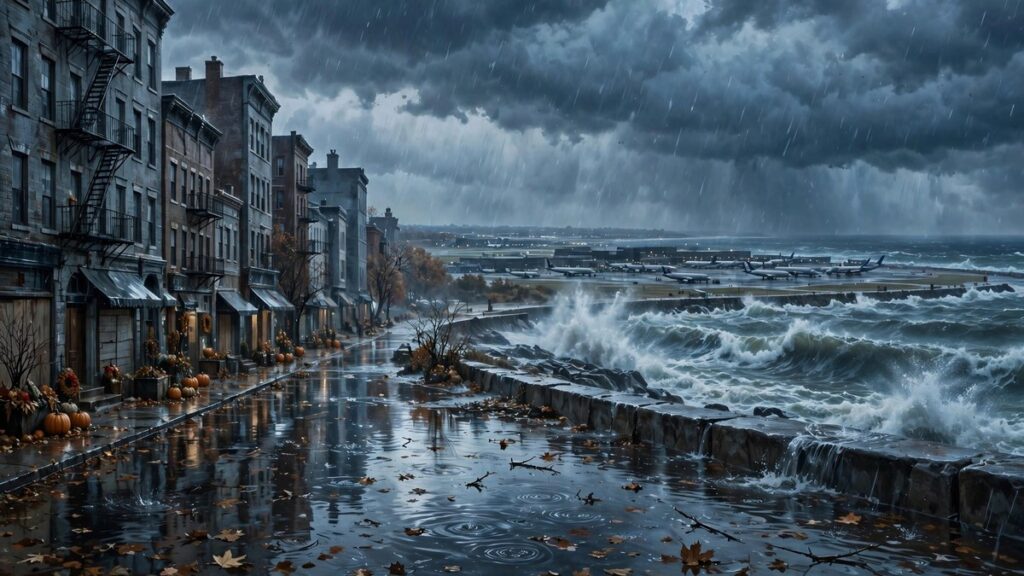
According to the BBC, a major Thanksgiving storm has brought flooding and flight delays across the United States, striking just as tens of millions of Americans travel for the holiday. Simple Flying reports hundreds of cancellations, with the worst disruption at East Coast airports.
The storm is the product of two low-pressure systems arriving at once, one off the north-west coast and one off the north-east coast. The Federal Aviation Administration has described this as the busiest holiday travel weekend in 16 years, with more than 80 million Americans expected to travel over the Thanksgiving period.
Flooding has hit both coasts. Streets were submerged in the Miami-Fort Lauderdale area, while floodwater covered roads and entered homes in Huntington Beach, California. New York City and New Jersey have declared states of emergency, with officials urging residents to exercise caution as the storm passes.
Flight-tracking data counted 396 cancellations and 1,053 delays for flights within, into or out of the United States. Baltimore-Washington airport saw 54 cancellations, John F. Kennedy airport 35 and Boston Logan 22. On Wednesday, the disruption was already severe, with more than 6,800 delays and over 60 cancellations recorded.
Why it matters
The timing is what turns a bad storm into a national disruption. Thanksgiving is the one weekend when tens of millions of Americans must all move at once, in the same direction, on the same few days. There is no slack in the system to absorb a shock: every cancelled flight strands passengers who cannot simply travel a day later, because the next day is just as full. That is why a storm that might pass unnoticed in February becomes front-page news in late November.
Timeline: on Wednesday 25 November, more than 6,800 flights were delayed and a FedEx MD-11 aircraft overshot a runway at Miami International Airport, prompting a ground stop. By Thursday 26 November, the coastal storm was hammering the Eastern Seaboard, states of emergency were in place in New York City and New Jersey, and hundreds more flights were cancelled as airlines slowed operations in low cloud, rain and strong crosswinds.
The geography of this storm is what makes it unusual. Two separate systems are striking at once, one on each coast, so there is no easy detour around the weather. The east is taking the worst of it, with driving rain, gusts of 40 to 60 miles per hour and coastal flooding, while the west faces flooded roads of its own. Airlines can reroute around one storm; they cannot reroute around a continent.
There is also a lesson here about how travel is planned in an age of record demand. The Federal Aviation Administration had already forecast the busiest holiday weekend in 16 years before the weather arrived, with more than 80 million Americans expected to travel. When forecasts and demand both point the same way, the system works only if the weather cooperates. This week it did not, and the cost falls on travellers, airlines and the small businesses that depend on holiday trade.
What to watch next
Watch the return journey on Sunday 29 November, expected to be the single busiest travel day of the period, when any backlog from Thursday and Friday will collide with fresh demand. If cancellations pile up again, the disruption could stretch well into the working week.
Watch power restoration and road reopenings along the East Coast, and whether airlines waive change fees as the storm clears. The speed of the recovery will tell travellers whether this was a one-day shock or the start of a difficult holiday weekend.
Frequently asked questions
Which US airports were hit hardest by the Thanksgiving storm?
Baltimore-Washington saw 54 cancellations, John F. Kennedy airport 35, Boston Logan 22 and Washington National 19, with delays concentrated at large East Coast hubs.
How many Thanksgiving flights were cancelled?
Flight-tracking data counted 396 cancellations and 1,053 delays for flights within, into or out of the United States, with the numbers changing through the day.
Why is Thanksgiving travel so busy this year?
The Federal Aviation Administration called it the busiest holiday travel weekend in 16 years, with more than 80 million Americans expected to travel.
What caused the flooding?
Two low-pressure systems, one off each coast, brought heavy rain, strong onshore winds and high tides, flooding low-lying streets from Florida to California.


