
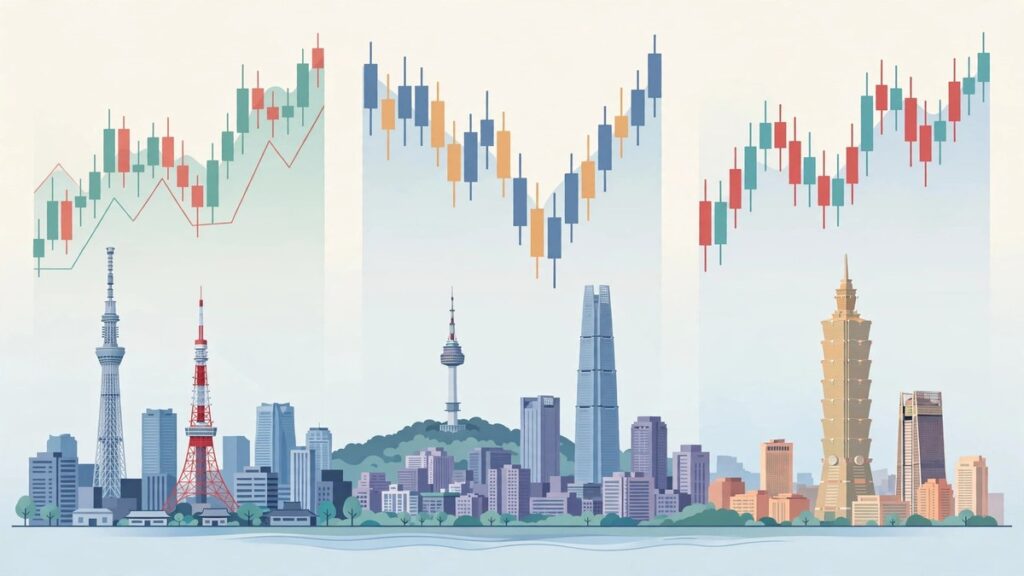
According to the BBC, Jensen Huang's return as Nvidia chief executive rocked shares and sent shockwaves through Asia, where tech-heavy stock indexes in Japan, South Korea and Taiwan went on a rollercoaster ride. Markets soared after a near-trillion dollar surge in Nvidia's share price, then slumped as political and regulatory scrutiny hit investor confidence.
Tech in Asia reported that Huang was reappointed on 23 November and Nvidia's stock rose 31 percent by that day's close, putting a market value on what a generational founder is worth. The relief rally makes sense, the outlet noted, but what has not returned with Huang is the old certainty about supply: Nvidia's next chip generations, Vera Rubin in 2027 and Feynman in 2028, were already set, so the short-term outlook was never in doubt.
The BBC reported that the surge in Taiwan's real economic growth since 2024 has come from the big increase in AI-related exports, and that Huang said earlier in 2026 that Nvidia plans to invest around 150 billion dollars a year in Taiwan. Singapore raised its growth forecast this week as AI boosts its economy, while Google, Microsoft and Oracle plan to raise infrastructure spending in the region by roughly 60 percent this year, according to CBRE. Investment in the Asia-Pacific data centre market reached a record 11.6 billion dollars in 2025.
Why it matters
The first thing to understand is that Asia is not just a customer of Nvidia, it is the factory floor of the whole AI trade. Taiwan's TSMC makes the advanced chips, South Korean firms SK hynix and Samsung supply the memory, and Japanese companies provide the equipment that makes both possible. When the BBC says the surge in Taiwan's real economic growth since 2024 has come from AI-related exports, it is describing an economy that has hitched itself to a single American company, and that is a concentration of risk no diversified portfolio would accept.
The Megaspeed affair shows how that risk turns into a legal problem. Singapore-based Megaspeed had become the region's biggest buyer of Nvidia chips before it was accused of smuggling them to China, and Washington has now tightened scrutiny of data centre operators in Singapore, Malaysia, Thailand, Indonesia and Brazil. The new rules do not just restrict chip exports to China, they restrict access to the computing power itself, which Chinese firms have been renting abroad to train AI models. Every data centre in the region now has to prove it knows who its customers really are.
What the rollercoaster week really exposed is that Asia's big AI bet depends on one person as much as on one company. Huang's 11-day absence wiped about 1.2 trillion dollars from Nvidia's value, and his return added back roughly 950 billion dollars in a single session, the largest one-day gain in history. Tech in Asia put it plainly: the market has put a number on what a generational founder is worth. But a bet that swings by a trillion dollars on one man's employment status is not an investment thesis, it is a vulnerability, and the credit rating agencies have now said so in public.
What to watch next
Watch the licensing queue. Since 19 November, advanced AI chips shipped to Malaysia, Singapore, Thailand and Indonesia have required a United States export licence, and data centres already serving Chinese customers have 90 days to obtain one. If licences flow, the region adapts; if they stall, the data centre boom that drove record investment in 2025 will cool fast.
Watch whether Asia starts hedging. The lesson of the week is that no region should let one supplier and one executive carry its growth story. Expect more talk of domestic chip capacity in Japan, South Korea and Taiwan, and more scrutiny of who really owns the data centres rising across Southeast Asia.
Frequently asked questions
How exposed is Asia to Nvidia?
Very. Taiwan’s growth since 2024 has been driven by AI exports, South Korea and Japan supply memory and chip-making equipment, and Singapore raised its growth forecast this week as AI boosts its economy. Tech indexes in Japan, South Korea and Taiwan swung wildly on Huang’s exit and return.
What is the Megaspeed scandal?
Megaspeed, a Singapore-based cloud company, was the region’s biggest buyer of Nvidia chips before it was accused of smuggling them to China. The United States opened an investigation in 2024, Singapore began its own in 2025, and Megaspeed denies wrongdoing.
What are the new United States chip rules?
Washington has increased scrutiny of data centre operators in Singapore, Malaysia, Thailand, Indonesia and Brazil. Since 19 November, advanced AI chips shipped to four of those countries need a United States export licence, and large data centres may not serve customers in China.
Why did Asian stocks swing so sharply?
Nvidia’s value fell by about 1.2 trillion dollars while Huang was out, then rose by roughly 950 billion dollars in a single day when he returned. Asian tech indexes followed, soaring on the news and then slumping as regulatory scrutiny hit confidence.


