
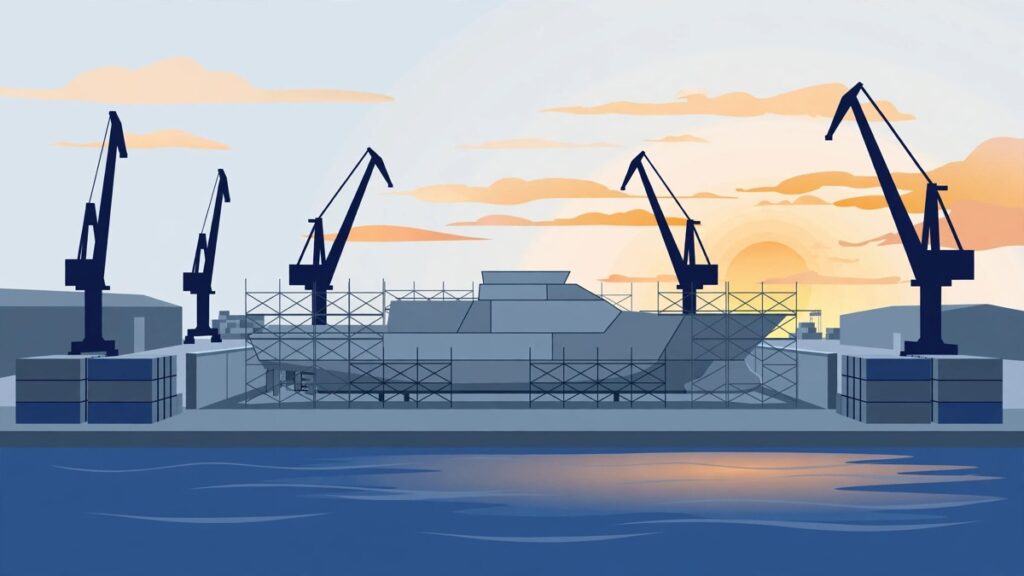
The White House's fiscal year 2027 budget asks for $65.8 billion for US Navy shipbuilding, the largest such request in more than six decades. The plan envisages 34 new Navy vessels, 18 warships and 16 support ships, plus a proposed Maritime Security Trust Fund to give shipbuilding a steady income beyond annual budget fights.
The spending plan builds on two policy documents: the Maritime Action Plan, released on 16 February 2026, and Executive Order 14269, Restoring America's Maritime Dominance, signed on 9 April 2025. Together they aim to revive an industry that has withered for generations, at a time when less than 1 percent of new commercial vessels are built in the United States.
A White House memorandum from August 2026 describes the problem bluntly: the Navy has suffered shipbuilding setbacks from overly complex designs and repeated design changes, producing cost growth, delays and cancellations, with large backlogs across six major shipbuilding programmes. The memorandum orders a fifth public Navy yard, a component repair centre, and a new approach to buying ships based on proven foreign designs, including the Finland model for icebreakers.
Why it matters
The US shipbuilding revival is a go-big-or-go-home moment because the gap is that large. China now builds most of the world's commercial ships, while the United States builds almost none, and the Navy's own shipyards cannot keep up with maintenance, let alone expansion. A country that cannot build, crew, repair and operate ships at scale cannot sustain a navy in a long crisis, and that is the argument The White House is making to Congress: shipbuilding is not an industrial subsidy, it is the foundation of sea power.
The boldest idea is not the headline number but the funding mechanism. The proposed Maritime Security Trust Fund would be paid for by a fee on foreign-built commercial ships calling at US ports, assessed on cargo weight, creating a dedicated revenue stream instead of an annual fight over appropriations. Holland & Knight estimates that a fee of one cent per kilogram could raise roughly $66 billion over ten years. The catch is that Congress must authorise it, and lawmakers rejected significant parts of last year's budget request.
Timeline: Executive Order 14269 was signed on 9 April 2025. The Maritime Action Plan followed on 16 February 2026, organised around four pillars: rebuilding shipbuilding capacity, reforming workforce training, protecting the industrial base, and supporting national and economic security. The White House unveiled the fiscal year 2027 budget on 5 April 2026, with $65.8 billion for Navy shipbuilding, and a further memorandum on rebuilding the Navy and the shipbuilding base followed in August 2026.
The workforce is the quiet constraint on the whole plan. Shipyards need welders, electricians and engineers, and the Maritime Action Plan itself identifies skilled labour shortages as a binding limit, calling for expanded training, faster Coast Guard credentialing and a 20 percent increase in cadet enrolment at the US Merchant Marine Academy. Money can buy steel and cranes, but it cannot conjure a generation of shipbuilders overnight, and that is where the go-big ambition is most likely to be tested.
What to watch next
Watch Congress, which controls the purse strings. The SHIPS Act and the Building Ships in America Act both enjoy bipartisan support, and the administration is preparing a further legislative package, but the trust fund fee will face intense debate from shippers and trading partners.
Watch the shipyards themselves. The first signs of success will be concrete: drydock upgrades, multiyear vessel orders, and training programmes filling up, rather than new announcements.
Frequently asked questions
How much is the White House asking for Navy shipbuilding?
$65.8 billion in the fiscal year 2027 budget, the largest request for naval construction in more than six decades, as part of a $1.5 trillion national security budget.
What is the Maritime Security Trust Fund?
A proposed dedicated fund for shipbuilding, fleet growth and workforce training, paid for by a fee on foreign-built commercial ships docking at US ports, calculated by cargo weight.
Why is US shipbuilding in trouble?
Less than 1 percent of new commercial vessels are built in the US, few domestic yards can handle large-scale construction and repair, and Navy programmes face backlogs from complex designs and repeated changes.
What is the Finland Model?
A White House plan to use the US-Finland memorandum on medium icebreaker construction as a template, letting foreign suppliers build early ships while building or buying a US yard, hiring American workers and licensing their techniques.


