
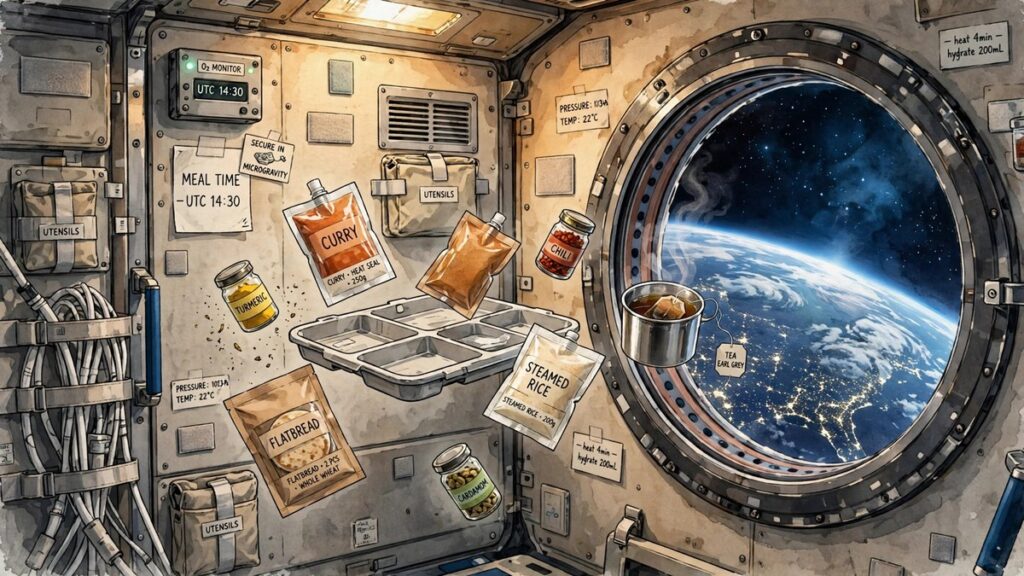
China prepared halal space meals for Muhammad Zeeshan Ali, Pakistan's first astronaut, for his stay aboard the Tiangong space station on the Shenzhou-24 mission, according to Startup Pakistan. The menu includes beef nihari, lamb korma, butter chicken and curried chickpeas, with more than 100 halal varieties prepared for the flight.
The China Astronaut Research and Training Center developed the menu after studying Pakistani food culture, halal requirements and nutrition standards, CCTV News reported, as carried by China Daily and reported by Around.pk. Researchers adapted items from China's existing space food library and created seven Pakistani-style space foods, with four dishes officially named so far. The entire production line followed halal standards, and each dish was taste-tested repeatedly before the recipes were finalised.
China also prepared operating manuals in both Chinese and English for Ali, according to Startup Pakistan, so he can communicate with his crewmates and follow procedures during the mission. Ali launched aboard Shenzhou-24 on 25 November 2026 at 8:18am Beijing time from Jiuquan, alongside commander Tang Hongbo and flight engineer Wu Yi, and docked with Tiangong three hours and 38 minutes later, becoming the first Pakistani and the first foreign astronaut to visit the station. He is on a short stay and is scheduled to return to Earth on Shenzhou-23.
Why it matters
Why it matters: food is the most human part of a space mission, and this menu is a small piece of diplomacy served on a tray. A space station is a closed, stressful environment where crews live and work in close quarters, and sharing a meal is one of the few normal things they do. When China builds a halal menu for its guest, it is telling Pakistan, and every other country watching, that Tiangong is not only a Chinese station but a place where a foreign astronaut's faith and culture are planned for in advance, not accommodated as an afterthought.
The detail in the preparation is what makes this more than a press release. The researchers did not simply label existing dishes halal; they studied Pakistani food culture and nutrition, created seven new Pakistani-style space foods, and designed lighter, easier-to-digest meals for the early part of the mission, with spices such as turmeric and curry. The original plan included Pakistani spiced milk tea, but after arriving in China, Ali said he enjoyed Chinese black tea and Chinese rice and asked for more of both to be packed, so those were added to the menu. That small exchange, a guest asking for the host's food as well as his own, is the kind of detail that makes international cooperation real rather than ceremonial.
According to Around.pk, this is the first time China has assembled a complete nutrition plan for an astronaut from a different food culture, covering research, ingredients, recipes and how meals are consumed in orbit. That matters because Tiangong's future depends on foreign partners, and every future guest will ask the same question Ali's team asked: will the station feed me properly, in a way that respects who I am? The answer China gives now will be remembered the next time it invites a partner aboard.
The mission itself carries weight beyond the menu. Ali is a payload specialist who will support Pakistani science experiments in life and materials sciences, focused on research relevant to food security and climate change, according to details shared with Reuters and reported by The News. The two countries signed their astronaut agreement in February 2025, and two Pakistani candidates trained in China before Ali was selected. The halal meals are the most visible part of that partnership, but the experiments are the part that may outlast it.
Timeline: February 2025 — Pakistan and China sign their astronaut cooperation agreement, and two Pakistani candidates begin training in China. 21 November 2026 — the final full-system launch rehearsal is completed at Jiuquan. 25 November 2026 — Shenzhou-24 launches at 8:18am Beijing time and docks with Tiangong three hours and 38 minutes later. About a week later — Ali is scheduled to return to Earth aboard Shenzhou-23.
What to watch next
Watch what Ali's experiments produce. The food security and climate research he is carrying out for Pakistan is the mission's lasting output, and results from orbit take months to analyse and publish.
Watch also who China invites next. If Tiangong hosts astronauts from more countries, the halal menu will become a template, and the station's claim to be an international platform will be judged on how well it adapts to each new guest.
Frequently asked questions
What halal dishes will Pakistan’s astronaut eat in space?
Beef nihari, lamb korma, butter chicken and curried chickpeas have been named so far, as part of a halal selection of more than 100 varieties. Seven Pakistani-style space foods were created for the mission, and Ali also asked for Chinese black tea and Chinese rice to be packed.
Who prepared the halal space meals?
The China Astronaut Research and Training Center developed the menu after studying Pakistani food culture, halal requirements and nutrition standards. The entire production line followed halal standards and each dish was taste-tested repeatedly.
How long will Muhammad Zeeshan Ali stay on Tiangong?
He is on a short stay of about a week, after arriving aboard Shenzhou-24 on 25 November 2026. He is scheduled to return to Earth aboard the Shenzhou-23 spacecraft.
Why does the halal menu matter?
It is the first time China has assembled a complete nutrition plan for an astronaut from a different food culture. It shows how Tiangong plans to host foreign astronauts, and it is a visible sign of the growing space partnership between China and Pakistan.


