
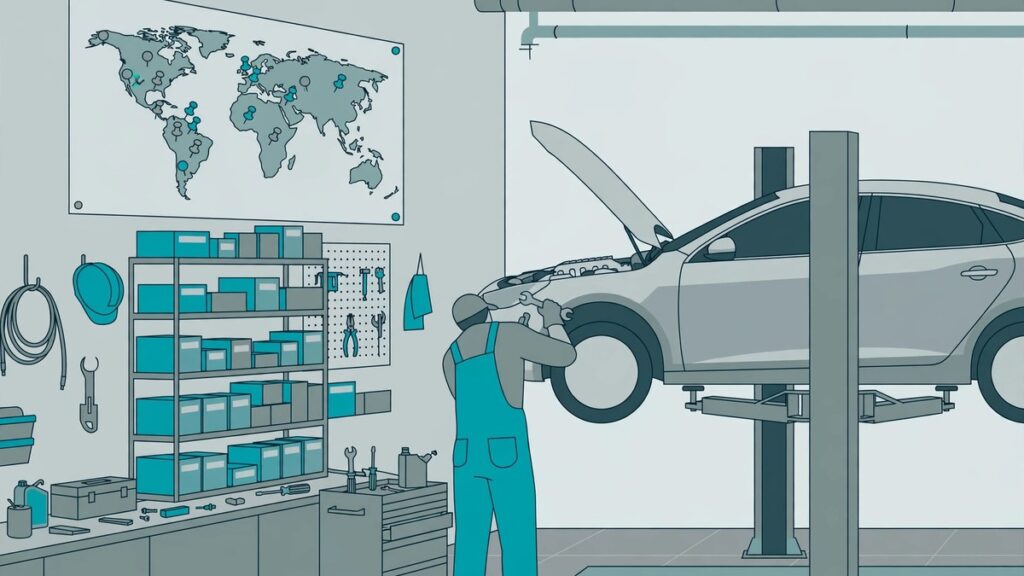
Chinese car brands OMODA and JAECOO say their after-sales support now reaches all 79 markets where their cars are sold, backed by 1,746 dealerships. The Wuhu-based brands announced the milestone on 18 November 2026, framing servicing and spare parts as central to keeping fast-growing sales from stalling, according to Startup Pakistan.
The scale of the operation is considerable for brands that only hit one million sales in three years. A regional parts centre in Dubai's Jebel Ali Free Zone, running since December 2024, covers 12,000 square metres and stocks more than 50,000 items, with a 95% parts fulfilment rate and a 100% rate for critical components, while parts for immobilised vehicles can be sent out within 24 hours. Shipping lead times in the Middle East have fallen to about nine days, against a typical 30-day overseas cycle, and regional parts warehouses in Europe and Latin America are planned to open in 2027.
Training sits alongside the parts network. A professional training centre in Warsaw opened in March 2026 with more than 700 dealership and service staff already trained, the Italian after-sales team has trained over 100 local service staff with Generali jeniot, and the UK team has built an eight-step diagnostic process for frontline technicians. In the UK, a September 2026 expansion of the RAC partnership lets 400 mobile mechanics carry out selected warranty and recall work at customers' homes or workplaces, while Australia has an eight-year capped-price servicing programme.
Why it matters
For a fast-growing Chinese carmaker, after-sales support is where export ambitions are won or lost. Selling a car is a single transaction; servicing it is a relationship that lasts years, and it is the part of the business that decides resale values, word of mouth and whether a buyer ever comes back. OMODA and JAECOO's pitch is that service capacity should be built before new models arrive, with local parts warehouses required before a launch, rather than improvised afterwards. That is the right order, because nothing damages a new brand faster than a customer waiting weeks for a part.
The numbers also reveal how the brands are positioning themselves against established rivals. Legacy carmakers spent decades building dealer networks; a newcomer cannot match that density overnight, so OMODA and JAECOO are substituting centralised parts hubs, mobile mechanics and fixed-price servicing for sheer numbers of workshops. The RAC deal in the UK is the clearest example: 400 mobile mechanics doing warranty work at a customer's driveway is a different model from a franchised dealer, and it may suit buyers who never wanted to visit a showroom in the first place. The question is whether mobile and centralised service can handle complex repairs as well as routine ones.
There is a risk in growing this fast, and the brands' own announcement hints at it. Entering 79 markets in three years means service teams, parts stocks and training all have to scale at the same speed as sales, and any gap shows up immediately in customer complaints. The 2026 Global After-Sales Skills Competition, which brought frontline staff together from markets including Pakistan, reads as an attempt to keep standards consistent across a very dispersed network. Consistency is the hard part: a customer in Warsaw, Dubai or Sydney should get the same answer to the same problem, and that is difficult when the network is still being built.
The broader story is the industrial one. Chinese car brands are no longer competing only on price and design; they are competing on the unglamorous infrastructure of ownership. OMODA and JAECOO's parent group has bet that hybrid technology, intelligent cockpits and styling will win showrooms, but the after-sales announcement shows it also understands that trust is built in the workshop. With 23 European countries already entered, the brands are now operating in markets where buyers have long memories about service, and where a single bad experience travels fast.
What to watch next
Watch the planned parts warehouses in Europe and Latin America in 2027, which will show whether the Dubai model can be repeated closer to the biggest export markets. If lead times fall in Europe as they did in the Middle East, the service story becomes a genuine selling point rather than a press release.
Watch the service metrics too. A 95% fulfilment rate is easy to hold at current volumes; the test comes as sales keep growing and as older cars start needing more complex repairs. Owner surveys and warranty claim data over the next year will say more than any announcement.
Frequently asked questions
How many markets do OMODA and JAECOO cover with after-sales support?
As of September 2026, the brands had entered 79 markets worldwide with 1,746 dealerships, and they say after-sales service coverage now extends to every market where their vehicles are sold.
What is the Dubai spare parts centre?
The Middle East Regional Spare Parts Distribution Center in Dubai’s Jebel Ali Free Zone opened in December 2024. It covers 12,000 square metres, stocks more than 50,000 items, and has cut regional shipping lead times to about nine days from a typical 30.
What does the RAC partnership mean for UK owners?
Since September 2026, RAC’s nationwide team of 400 mobile mechanics can carry out selected warranty repairs and recall work for OMODA and JAECOO at customers’ homes or workplaces, instead of the owner visiting a service centre.
Why does after-sales matter so much for a new car brand?
Servicing, repairs and parts availability decide whether owners trust the brand long term, and they shape resale values and word of mouth. For a brand expanding as fast as OMODA and JAECOO, service capacity has to grow at the same speed as sales or complaints follow quickly.


