
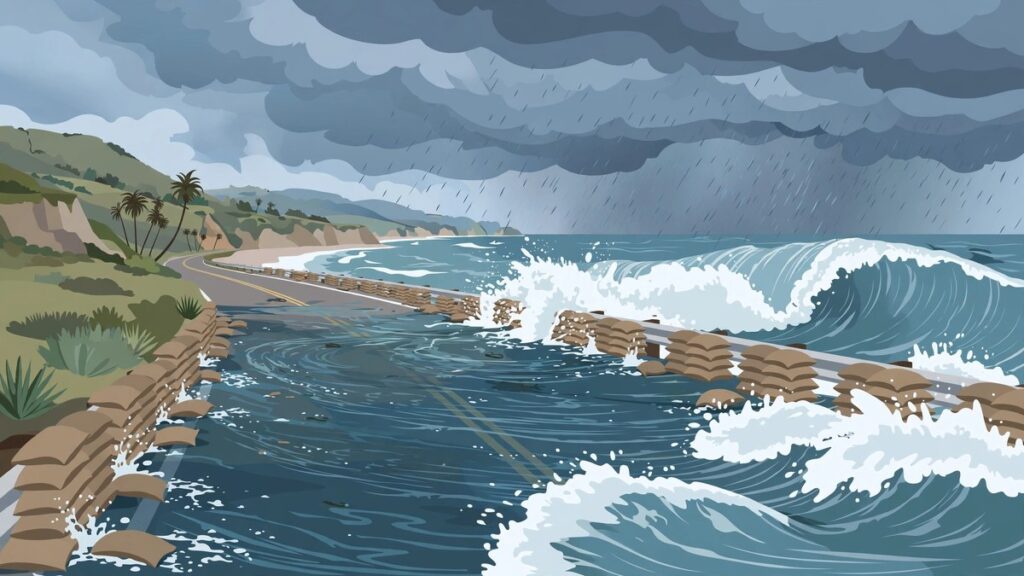
High king tides flooded low-lying communities on both coasts of the United States during Thanksgiving week, with water levels in San Francisco breaking a November record. Forecasters warned the flooding could continue through Thursday 26 November 2026, as the year's highest tides combined with a strong El Nino. The king tides flooding is expected on both coasts, according to Associated Press (via WSOC TV).
In the San Francisco Bay Area, tides were expected to peak on Wednesday at 2.8 feet above normal, close to the record of 2.9 feet set on 27 January 1983. The city's Embarcadero waterfront, which flooded during heavy rain the previous week, was again at risk, and the National Weather Service warned of waves 20 to 30 feet high.
According to the Associated Press, the tides were also expected to cause coastal flooding in the Pacific Northwest and in South Florida, from Palm Beach to Miami. In Humboldt County near the Oregon border, the sheriff's office ordered evacuations in a small coastal community where some buildings had already flooded on Monday.
Why it matters
King tides are the highest tides of the year, and they happen when the gravitational pull of the moon and sun lines up to raise water levels further than usual. That alone would be enough to flood low-lying streets, but this year's tides are being amplified by a super El Nino, which has warmed the ocean and increased the volume of seawater, according to the Associated Press. The result is water arriving higher, staying longer, and combining with storm surges to push further inland than the astronomical tide alone would reach. The National Weather Service said storm-driven surges could add as much as 1.6 feet to the normal tides in the Bay Area, which is why a predictable annual event has turned into a week of warnings, evacuations and road closures.
The human cost is visible in the small places. In King Salmon, a coastal community in Humboldt County, restaurant owner Avishai Leibson told the Associated Press that his staff were barricading the building with sandbags and pumping water out, with appliances raised a foot off the ground on cinder blocks. He said they were turning into a lake and joked they might need to change the name to Falafelove Island, but the joke carried the strain of a business owner watching the sea come through his door. In San Francisco, workers fanned out along the Embarcadero to clear storm drains and erect barriers, while the mayor toured flooded areas and urged residents to prepare. In Washington State, ferry sailings were cancelled, disrupting about 300,000 people expected to use the system over the holiday weekend, and heavy snow in the mountains threatened travel over the passes.
The timeline shows a week that kept getting worse before it got better. On Monday, buildings flooded in the King Salmon community and evacuations were ordered, with residents told to leave by Tuesday morning. On Tuesday, the tides pushed the water level at San Francisco's Crissy Field to 8.23 feet, breaking a November record of 7.97 feet set in 1982, according to the National Weather Service as reported by KION. More records were expected to fall on Wednesday morning, when the highest tides were forecast to reach 8.5 feet, or 2.7 feet above normal, with Monterey forecast to reach 8.4 feet. Coastal flood warnings for the San Francisco and San Pablo bayshores were in effect from Monday morning until Thursday afternoon, and in South Florida water levels were expected to stay elevated for hours around high tide on Wednesday and Thursday mornings.
For coastal planners, a king tide week is a live rehearsal for the future. The tides themselves are natural and predictable, but they arrive on top of seas that are higher than they used to be, and the flooding they cause today in places that have never flooded before, such as parts of Alameda, is a preview of what everyday tides may look like in a warmer world. That is why emergency managers in the Bay Area were warning of evacuation orders in neighbourhoods with no history of flooding, and why the mayor of San Francisco urged people over the weekend to consider avoiding holiday travel. The immediate danger this week is water on roads and waves sweeping people off rocks, but the longer lesson is about where it is safe to build, to live and to drive when the sea keeps rising.
What to watch next
Watch the Wednesday and Thursday morning high tides, when the highest water levels of the week are expected and more records could fall in San Francisco and Monterey. Watch South Florida too, where king tides are expected to flood coastal areas from Palm Beach to Miami, and where communities were only just drying out after storms dumped more than 17 inches of rain less than a week earlier.
Watch the St. Johns River near Cocoa, which has been above flood stage since 2 November and broke a record set in 1953 last week, and watch whether the flooding changes any travel plans for the Thanksgiving weekend. Longer term, watch how cities respond, because the places that flooded this week will be the first to demand stronger defences.
Frequently asked questions
What is a king tide?
A king tide is one of the highest tides of the year. It occurs when the gravitational pull of the moon and sun aligns to raise water levels further than usual, typically around a new or full moon.
Why are this year’s king tides so high?
The astronomical tides are being amplified by a super El Nino, which has warmed the ocean and increased the volume of seawater, and by storm surges that can add more than a foot to the normal tide. The combination has pushed water levels to record heights in places like San Francisco.
Where is the flooding worst?
The San Francisco Bay Area has seen the worst flooding so far, with water levels breaking a November record, evacuations in Humboldt County, and road closures across Marin County. Coastal flooding is also expected in the Pacific Northwest and in South Florida, from Palm Beach to Miami.
Is it safe to visit the coast during king tides?
The National Weather Service warns that waves can sweep people off rocks, knock them off their feet and pull them into the ocean, with breaking waves of 20 to 30 feet forecast in the Bay Area. Officials advise against driving through floodwater or going around barricades.
Are king tides caused by climate change?
No, king tides are a natural astronomical event. But they offer a preview of higher sea levels, because the flooding they cause today shows what everyday tides could look like in future as seas rise.


