
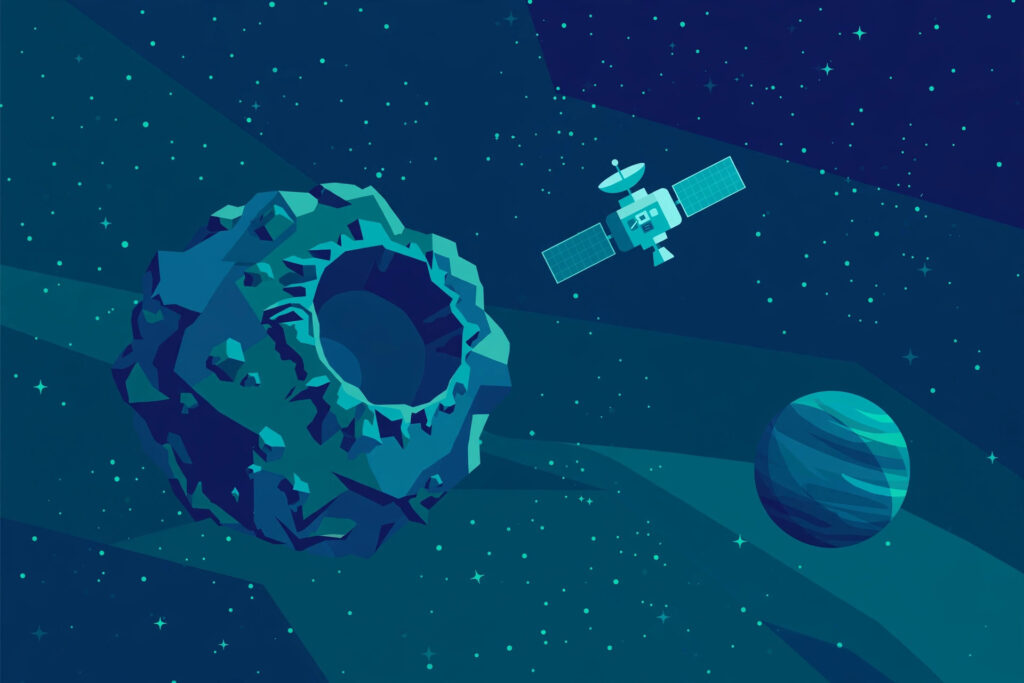
New images from the European Space Agency's Hera spacecraft have revealed the Dimorphos asteroid crater, a dramatic scar left on the asteroid by humanity's first test of planetary defence, a crater the size of a sports stadium that flattened one face of the small space rock.
Dimorphos, a 151-metre-wide moonlet orbiting the larger asteroid Didymos, was struck by NASA's DART spacecraft on 26 September 2022 in a deliberate collision that shortened its orbit by 33 minutes. Hera arrived at the pair in October 2026 to study what the impact actually did to the asteroid.
The images, released on 25 November 2026, show that the side hit by DART is now completely covered by the crater, while the rest of Dimorphos looks largely unchanged. The asteroid is also tumbling chaotically in its orbit, and hundreds of previously unknown boulders have been found circling the pair.
Why does a crater on a distant rock matter for Earth?
The reason is simple and sobering: one day, humanity may need to do this for real. The dinosaurs did not have a space programme, as the team that unveiled the images in Berlin's natural history museum pointed out, and the 66-million-year-old impact that ended their reign is the reason planetary defence exists at all. DART proved that a spacecraft can change an asteroid's orbit; Hera is now answering the harder question of how and why it worked, so that a future deflection can be relied upon rather than hoped for.
The images contain a genuine scientific surprise. Researchers had debated whether Dimorphos would show a crater, change shape or stay the same, and the answer turned out to be all three at once: one face flattened into a stadium-sized crater, the rest of the body barely disturbed. That uneven result tells scientists something important about how rubble-pile asteroids absorb an impact, and it means future deflection models cannot treat asteroids as solid billiard balls.
The tumbling and the boulders add to the picture. Dimorphos now rotates chaotically, like a barrel thrown down stairs, in the words of one mission scientist, and hundreds of boulders a few metres across are drifting around the pair, some of them large enough to matter for any spacecraft flying close. Hera's team must now navigate that debris field while moving closer, from about 25 to 30 kilometres away today to around 13 kilometres in December.
There is also a lesson here about international cooperation that is easy to overlook. NASA built the hammer, Europe built the inspection team, and Japan contributed instruments, with 18 European states involved in building Hera. Planetary defence is one of the few endeavours that genuinely belongs to all of humanity, since an asteroid does not respect borders. The fact that it worked, and that the follow-up is shared openly, is a model for how science can function when the stakes are planetary.
Timeline: the Dimorphos mission
- 26 September 2022: NASA’s DART spacecraft strikes Dimorphos in a deliberate collision, shortening its orbit by 33 minutes.
- October 2026: The European Space Agency’s Hera spacecraft arrives at Didymos and Dimorphos to study what the impact did.
- 25 November 2026: Images are released showing a stadium-sized crater covering the side DART hit, with Dimorphos tumbling chaotically and hundreds of previously unknown boulders circling the pair.
- December 2026: Hera is planned to move closer, from about 25 to 30 kilometres away to around 13 kilometres.
- January 2027: Two shoebox-sized CubeSats are planned to deploy and probe the asteroids’ interiors with radar.
What should you watch next?
Watch Hera's closer approach in December, when higher-resolution images should let scientists calculate Dimorphos's mass, and the deployment of two shoebox-sized CubeSats in January 2027 that will probe the asteroids' interiors with radar.
Watch the Ramses mission, being developed with Japan to study the asteroid Apophis during its close flyby of Earth in April 2029, which will test how a real asteroid responds to a planet's gravity.
Frequently asked questions
What is Dimorphos?
It is a 151-metre-wide asteroid moonlet orbiting the larger asteroid Didymos, about 193.5 million kilometres from Earth.
What did NASA’s DART mission do?
On 26 September 2022, the DART spacecraft deliberately collided with Dimorphos, shortening its orbit around Didymos by 33 minutes in the first test of asteroid deflection.
What has Hera found?
Hera’s images show a stadium-sized crater flattening one face of Dimorphos, chaotic tumbling, and hundreds of previously unknown boulders circling the pair.
Why does planetary defence matter?
It aims to prove humanity can deflect an asteroid on a collision course with Earth, a threat that ended the dinosaurs 66 million years ago.


